
Iran ignores nuclear deadline
WASHINGTON – A defiant Iran faced the prospect of economic sanctions after United Nations inspectors reported the country had ignored Thursday’s deadline to halt its nuclear program and was hindering efforts to determine whether it sought to secretly develop nuclear weapons.
President Bush called Iran a “grave threat” and said “there must be consequences” for Tehran’s actions. “It is time for Iran to make a choice,” Bush said in a speech to the American Legion’s national convention in Salt Lake City.
His administration had offered to join talks with Iran and held out the possibility of future cooperation after 27 years of enmity, if Tehran met the U.N. deadline for suspending its nuclear program. Thursday, however, U.S. officials said they will demand international sanctions against the Iranian government.
“We are going to move this toward a sanctions resolution at the United Nations,” said R. Nicholas Burns, undersecretary of state for political affairs. “We expect others to join us.”
It is unclear how much support the White House has for the tough measures it hopes will force Iran to abandon a nuclear effort that has become a source of national pride. No world leader who commented on Thursday’s events spoke in the stark terms that Bush used, and none of the president’s closest allies said sanctions were a certainty.
European officials expressed dismay with Iran but emphasized a commitment to negotiations; they scheduled a meeting next week with Ali Larijani, the Iranian government’s point man on nuclear issues.
Since his 2002 State of the Union speech, when Bush singled out Iran as part of an “axis of evil,” he has tried without success to roll back Tehran’s nuclear energy program. He has asserted, without offering proof, that it is a cover for weapons development.
Iran has insisted that the nuclear program, which it kept hidden for 18 years, is for the production of peaceful energy, which it has a right to develop.
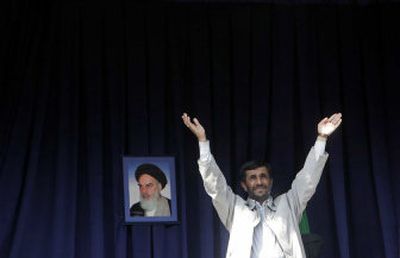
“The Iranian nation will not accept for one moment any bullying, invasion and violation of its rights,” Iranian President Mahmoud Ahmadinejad said. He called the United States government “tyrannical.” His foreign minister said Iran’s program is transparently peaceful and will continue.
In Thursday’s report, nuclear inspectors with the International Atomic Energy Agency detailed a mountain of circumstantial evidence, collected in the last three years, that suggests Iran is still concealing aspects of is nuclear program.
But IAEA officials noted Thursday that they have not found proof of a weapons program and said Iran is still complying with basic, mandatory inspections that allow the agency to monitor all of its work with uranium. That access enabled the IAEA to report that Iran had “not suspended its enrichment related activities,” as the Security Council required it to do by Thursday.
Inspectors reported that since April, when Iran began enriching uranium in a string of centrifuges, it has produced about six kilograms of uranium to levels consistent with an energy program. The material cannot be used for a weapon. Iran began enriching another small quantity last week, but inspectors wrote that there have been more substantial pauses than progress. They noted that the Iranians are working at a much slower pace than the IAEA, outside nuclear experts and some foreign intelligence agencies had forecast.
Russia and China were reluctant to impose sanctions even before the report came out, playing down the need just weeks after U.S. officials felt they had received assurances from both countries to support such measures. Although many countries appear to share U.S. suspicions about Iran’s intentions, they have profound differences with the Bush administration over how to respond and are apprehensive about the goals of a U.S. president who has said that “all options are on the table” in dealing with Tehran.