
Where the buffalo roam

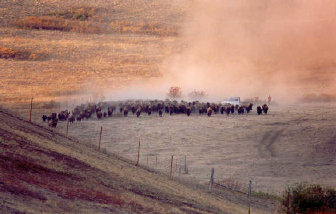
The old Western song with the words “Give me a home where the buffalo roam” takes on a whole new meaning after witnessing a roundup at the National Bison Range near Moiese, Mont. Anyone who has seen a herd of bison and thinks that they are managed like beef cattle needs to check out this annual event.
You will think twice about trying to creep up to one of these docile-appearing animals to get a better photo on the bison range or in Yellowstone National Park. They are huge, very powerful animals that can be temperamental, extremely fast and sometimes just plain mean when they get stirred up. Getting rounded up, herded into pens, squeezed, branded, electrically probed, shot with vaccines and receiving ear chips, not surprisingly, stirs these animals up. A cowboy would probably call them “real rangy.”
Bulls can weigh up to 2,000 pounds. The U.S. Fish and Wildlife Service uses specially designed reinforced steel fencing, chutes and pens. Only specially trained riders and horses need to apply for this job. Horses know that bison smell different than cows. A normal horse would not do well on this range. But despite the electronic scales, the implanted computer chips and the electric razor used before branding, there is a resemblance and nostalgic feeling of witnessing an old Western cattle roundup. Cowboy hats and branding irons are still part of the American West.
The U.S. Fish and Wildlife Service, which manages the herd, has good reasons to risk injury to its employees as well as the bison for two or three days each year during the roundup. There are about 370 bison on the range and each year 89 percent of the cows produce calves. That number means about 100 new animals added to the herd, which if left unchecked (as in Yellowstone) would cause serious over grazing on the limited, fenced bison range.
What happens to the excess bison? Each year a sealed bid sale is opened in August. Not just the new calves are sold. A proper age and composition in the herd is maintained. Some of the animals are donated to other parks, refuges and private herds. The majority of the bison are sold.
The bison certainly get the attention on this range but there are an amazing number and kinds of other large wild animals. The place is a wildlife watcher’s delight. Antelope, elk, mule deer, white-tailed deer and bighorn sheep may be spotted. If you want to experience the old West today, check out the National Bison Range in the fall.
In the winter, some of the gravel roads are closed and snow can temporarily close the refuge. The roundup is in early October and interested travelers need to contact the visitor center for details. Arrive early (around 8 a.m.) to catch the bison herd being driven to the corral for processing. The main purpose of the roundup is to handle the vaccinations, branding and sale of the bison. Visitors are allowed to watch but there is limited parking and a fairly small viewing area. Choice viewing spots are crowded because of school buses full of local kids taking in the event. It is a busy event especially between 9:30 a.m. and 1:30 p.m. when school groups are present. Early morning and late afternoon (before 4 p.m.) will provide the least crowded viewing time. Also these times are best for spotting on the surrounding range other large animals. The normal entrance fee is waived during the roundup.