
Road to riches
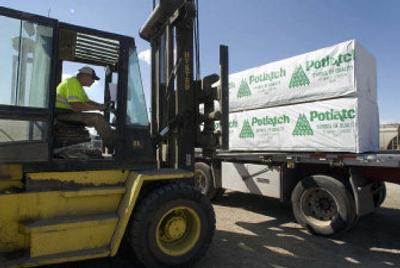
About 50 trucks deliver medicines, medical supplies and equipment, food and office supplies to Sacred Heart Medical Center every day, with more than half of them coming from the Puget Sound area, according to a state report.
They take Interstate 90.
In fact, most medicines in this part of the state come from the West Side, illustrating I-90’s importance to the Inland Northwest, said Barbara Ivanov, director of the Washington state Department of Transportation’s Office of Freight Strategy and Policy in Olympia.
“It’s fundamental. There is no other route,” she said. “If you can’t get medicines in for your health care system, how long will your health care system be running?” This year marks the 50th anniversary of the creation of the nation’s interstate highway system. I-90, which stretches from Seattle to Boston, holds the title of the longest highway in that system, at 3,081 miles.
To the Inland Northwest’s economy, I-90 is vital. The freeway allows our products, especially agricultural commodities, to head west to domestic and international markets, and tourists and goods to return.
“About one-quarter of Spokane’s output is going to Puget Sound in trucks,” Ivanov said. “If Spokane had no export or route to the coast, what would happen?”
Eighty-seven percent of trucks leaving Spokane in 2003 went west on I-90, according to a December 2005 WSDOT report. All told, 13,500 semi-trucks pass over Snoqualmie Pass each day, carrying $527 million worth of goods, Ivanov said.
Every day, 2,400 semi-trucks enter Spokane County, and 1,900 leave, many of them using the freeway, she said.
Inland Empire Distribution Systems in Spokane Valley relies on I-90 for its business of moving and storing others’ products.
Nearly all of the company’s 20 trucks that travel within 150 miles of Spokane use I-90, said Matt Ewers, vice president of business development. Ewers, who’s also chairman-elect of the Greater Spokane Valley Chamber of Commerce, attended and spoke at a freight transportation summit in Spokane Valley in June.
Because there aren’t stoplights and intersections on the freeway, using that route saves his company fuel costs and allows for cheaper, faster, more environmentally friendly travel, he said. Cost reductions are passed on to the customer.
“From a transportation standpoint, going east and west, it’s essential for moving cargo,” Ewers said.
Businesses in the Spokane area told WSDOT the transportation system is so efficient here that moving expenses represent a comparatively small percentage of their products’ final cost.
On average, Spokane manufacturers reported in a survey that 6.4 percent of their products’ costs were attributable to transportation expenses, the lowest of the six Washington regions surveyed, according to July 2004 state data. The next-lowest was wheat growers in southeast Washington, at 8.36 percent. The highest was manufacturers in the southern end of the Puget Sound region, who reported 14.12 percent of their products’ final costs came from transportation.
Ivanov said she can only guess at the reasons for that, but she predicted that congestion on West Side arterials drives up costs there.
According to the 2005 state report, almost 52,000 Spokane-area jobs rely on freight transportation, with most coming from manufacturing industries that have an average wage of more than $38,000 a year.
Although vacationers that aren’t part of large groups or tours are difficult to track, a significant number of tourists come into the area on I-90, said Harry Sladich, president and CEO of the Spokane Regional Convention and Visitors Bureau.
As of July this year, the CVB had more than 18,000 requests for information at its downtown and Stateline offices. At the Stateline office, which is only accessible by I-90, 1,454 visitors were recorded in July. At the downtown office, 8,927 were recorded that month.
Tourists visiting Spokane County spent $648.1 million here in 2004, generating almost $50 million in tax receipts locally and for the state, according to an October 2005 state Department of Community, Trade and Economic Development report.
Many of them came from Montana, largely because they don’t have the shopping opportunities that are here in Spokane, Sladich said.
“It’s all made possible because it’s not a seven-hour trek anymore. It’s a several-hour drive down the interstate,” he said.