
No kokanee fishing
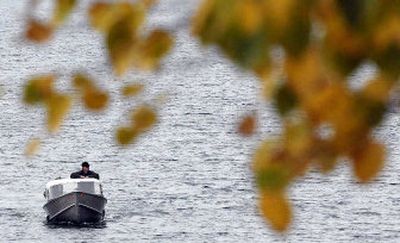
Kokanee fishing has been banned on Lake Coeur d’Alene until the Idaho Department of Fish and Game sees a boost in the feisty salmon’s population.
Monday’s emergency closure applies to all but the southern end of the lake, which is controlled by the Coeur d’Alene Tribe and comes just as the weather cools and bites increase on a favorite lake for kokanee anglers.
Tribal spokesman Quanah Spencer hadn’t yet talked to the tribe’s fish experts and had no comment on the state’s action or whether the tribe would shut down kokanee fishing. In the fall, however, kokanee migrate to the northern end of the lake to spawn.
Fish and Game Regional Supervisor Chip Corsi said the closure is a conservation effort that will boost the kokanee population, meaning more fish, happier anglers and cash for local business owners.
Kokanee fishing is one of the most popular activities on Lake Coeur d’Alene, which in 2003 was ranked by the state as the most heavily fished body of water in Idaho. That same year, fishing added an estimated $6.9 million to the local economy, Corsi said.
Yet not all fishermen are happy with the move, with some suggesting lowering the limit from 25 fish per day as a start.
“I’m looking at a wall of kokanee spinners that I have to find something else to do with,” said Jeff Smith, who sells Jack-Lloyd lures and wedding ring spinners at his Fins and Feathers Tackle Shop on Sherman Avenue. “Hopefully this is a temporary thing.”
Corsi said the closure is likely short term, a hiatus to give the landlocked sockeye salmon, also known as bluebacks, time to mature and spawn. He expects the recovery to be quick.
The state ordered the emergency closure after summer trawls showed a decline of hundreds of thousands of mature and 2-year-old kokanee.
The initial decline of kokanee likely was triggered by record floods in 1996-97 that flushed many fish from the lake. As the number of kokanee decreased, the remaining fish grew larger. That’s likely why some anglers may not have noticed the decline. Larger fish are more adept at feeding, meaning an easier catch. Big, easy-to-catch fish ultimately attract more fishermen.
Another factor is an increase in the chinook salmon population, a species that feeds on young kokanee.
Lake Coeur d’Alene needs a healthy population of both kokanee and the larger chinook, which is considered a trophy fish, Corsi said.
He said a temporary ban is needed to keep Lake Coeur d’Alene from having a kokanee crisis like Lake Pend Oreille or Priest Lake.
Kokanee fishing was permanently banned on Lake Pend Oreille in 2000. The fish began to decline in the mid-1960s when the U.S. Army Corps of Engineers dropped the winter lake level. Combined with a boom in lake trout, which eat kokanee, the species tanked.
Today commercial fishermen are netting lake trout and the state is paying a $10 bounty for every lake trout or rainbow trout longer than 12 inches that an angler catches. The goal is to revive kokanee by getting the predator-prey ratio in balance.
The kokanee population in Priest Lake also crashed, mostly because in the 1960s the Fish and Game Department introduced mysis shrimp in an effort to increase the kokanee size, Corsi said. The kokanee did grow but so did the survival rate of the lake trout, which ate the kokanee.
“You couldn’t scare up a kokanee if you tried,” Corsi said about Priest Lake.
This is the exact situation the department is trying to avoid in Coeur d’Alene.
“We aren’t in danger of losing them, but we are in danger of the population taking a big dip and we would lose a lot of fishing activity and opportunity for folks to go fishing,” Corsi said.
Last week the department asked the public whether they would prefer a complete closure or just shutting down kokanee fishing on the north end, where the fish congregate to spawn.
Of the 50 respondents, 66 percent supported a complete closure on the lake.
“Although I enjoy fishing for them very much I do not want to see the population dwindle,” Diane Howard of Rathdrum wrote in an e-mail to the department. “Good regulations and early determination of possible problems is what the Fish and Game is all about.”
Mickey Sigars, 77, of Coeur d’Alene, was devastated to hear about the closure.
“I’m almost 80 years old and that’s the only thing I can do is go fishing,” said Sigars, who enjoys eating his catch. “I don’t have much time left.”