
Perfect paths require a plan
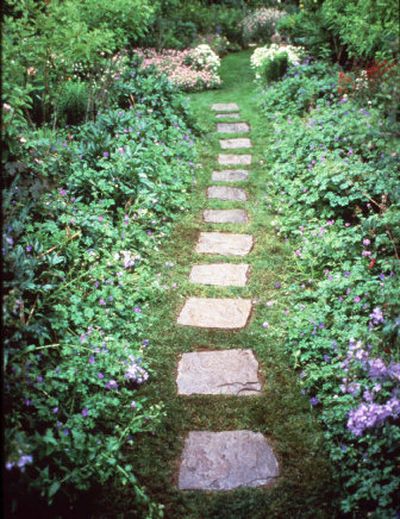

NEW MARKET, Va. — It isn’t easy to improve upon nature, but then there’s nothing in the landscaping rulebook banning imitation.
Take recreational trail building, for instance. The process should be more creative than building a convenient corridor from point A to point B.
People who design greenscapes for a living consider it a great compliment when told their latest creation blends well with the surroundings, that the trail looks as though it’s always been there.
“Start with a concept of where I want to go and what I want to do,” suggests Troy Scott Parker, author of “Natural Surface Trails by Design,” and president of Natureshape, a trail design and research service at Boulder, Colo.
“Go find the beauty spots on your property, the places that have character. By that I mean water, rocks and trees. You want to connect those. Incorporate them. Place them right alongside (the trail), in the middle or someplace where you can reach out and touch them.”
Anyone considering paths through their property shouldn’t get hung up over the physical part of the project, Parker says. Concentrate instead on the spiritual.
“Listen to your feelings and be clear about your interests. What is it that you want from your (trail) experience? If you don’t ask questions, you won’t get what you want.”
It isn’t necessary, by the way, to have several acres of land for a residential trail. Even a city-sized lot will do. The key is making it so attractive and interesting that anyone using it looks forward to seeing what waits around the next corner.
“Gateways” are great devices for leading people down a garden or woodland path, Parker says. That includes such things as gates and arbors, pergolas and overhanging trees — anything that takes you between two vertical objects.
“It’s kind of like having a tunnel when you add a gateway,” he says. “It makes you feel like you’ve gone through some kind of cleansing process. Every temple has several small gateways to make you feel you’re going deeper and deeper, spiritually. The more gateways or events you have on a trail, the more you feel like you’re getting away from the urban world and more into the natural world.”
Unless you plan to run equipment over your recreational trail, or expect a lot of foot or bicycle traffic, you need not build it any wider than 16 inches, Parker says. “Something as small as 12 inches you can walk on but it’s not very comfortable.”
It’s often easier to start a virgin trail than improve upon an existing one, he says. “If you just want to create a trail through a meadow, use a lawnmower. In a wood lot, simply `walk it in’ over the (fallen) leaves. Over time, they’ll compact underfoot and form a trail. Put down a few flagstones if you’re heading for the garden.”
Taking an inventory is one of the most important things you can do when planning trails, says Nancy Coverstone, an extension educator with the University of Maine.
“There’s nothing worse than unintended consequences that you have to fix,” she says. “The inventory can take several years or more but you need to visit the areas you’re considering in every season because you won’t know there’s a vernal pool in there, perhaps, if you don’t see it in April. They dry up as part of the natural life cycle.”
Research shows people often do more harm than good when scraping new trails through a patch of woods, alongside ponds or across a clearing.
“The impacts are mostly on wildlife, plants, soils and water,” Coverstone says. “If they’re disturbed over a long period of time, it degrades the area and the quality of wildlife viewing.
“Your goal is a dry trail system and not having it running along low-lying areas or on top of ridges. If there’s an existing trail and you see saturated, compacted soil, you can re-site it to a more appropriate area with plants appropriate to the area.”
You also can minimize the impact on such things as wildlife, wildflowers and berry bushes by running smaller, dead-end walkways off the primary trails, she says.
“Build viewing areas so you can keep some distance between people and nesting sites. Never run a trail along water but have a spur from the main trail lead to a single point. That way you can observe the water and quietly watch wildlife. If you have a place to sit you may not see where birds are nesting but you’ll be able to enjoy their calls.”
One of the pleasant results that can come from trail building is honing your observation skills, Coverstone says.
“You develop a habitat eye. You look at some vegetation and say, `Oh, good nesting cover.’ Or, `Oh, a good food source for migrating warblers.’
“It’s the observation, then, that really brings people closer to the earth. It’s being part of nature. It’s participating in it and not being of it. It becomes intimate.”