
Construction concerns
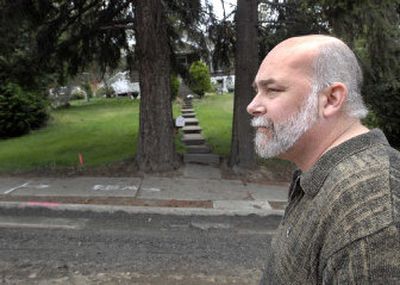
For most people, the Freya Street construction has been nothing more than an inconvenience.
But, for one disabled Freya resident, dealing with the roadwork landed him in the hospital.
Stewart Hightower, a 48-year-old husband and father, suffers from neurosarcoidosis, which he acquired 10 years ago from an immune system disorder called sarcoidosis. Sarcoidosis can occur in almost any part of the body, although it usually affects some organs more than others.
One of the two places it usually starts is in the lungs, as in Hightower’s case. As a result, he has trouble breathing. On good days, he said, walking more than 200 feet is difficult. Walking across Freya and up his driveway is nearly impossible. When he was forced to because of construction, he collapsed and was admitted to Sacred Heart Medical Center for 2 ½ days.
Hightower is asking the city to give disabled citizens better warning when roadwork may prevent disabled people from using their driveways.
Tom Arnold, city director of engineering services, said the city is willing to accommodate people with special needs. The key, he said, is for the residents to contact the city, ideally during the design stage of a project.
Hightower’s ordeal happened Sept. 11, the day road workers began tearing up Freya between 11th and 18th avenues. The Hightowers live on the west side of Freya near 12th Avenue.
Hightower said when he returned home after a doctor’s appointment for a pulmonary-function test, every side street was blocked.
“I tried to wave down one of the guys who was working and he just shook his head and went right back to work,” Hightower recounted. “When I honked, he and another guy continued to work.”
Hightower said the closest he could park to his house was at the end of 13th Avenue. When he made it to his driveway, he said, he fell to his knees, gasping for air. After calling his doctor, he drove to the hospital where he was put on oxygen and run through a battery of tests. Hightower also lost three days of work at his printing job.
Along with the city’s way of dealing with disabled residents, Hightower said he was equally disappointed with the workers’ reaction when he became ill.
“Wouldn’t it just be basically human if you see somebody gasping for air on their knees, grabbing their chest to come up and find out if they needed to call 911?” Hightower asked.
“If nothing else,” he added, “the city should take responsibility for the people it hires.”
Arnold, who spoke to Hightower on the phone while he was in the hospital, said he can’t tell the contractor how to respond in situations such as Hightower’s.
“That’s their own personal choice,” Arnold said.
“But what we can do is have the contractor keep his driveway open. From the city’s perspective, I personally called our field inspector and asked him to get ahold of Mr. Hightower and make sure he’s available. We both agreed this is a special circumstance and we need to do everything we can do to work with this gentleman and give him a contact.”
Hightower said since last week’s roadblock problem, the city “has been very careful to keep it open.”
“They’ve been much better about marking which streets are open as well,” he added.
Hightower has been given the cell phone number of the project’s field engineer. Work on his portion of Freya probably will take about a month more to complete.
Hightower’s predicament also should serve as a reminder for others who may find themselves in the same situation. Although fliers are distributed to residents who will be affected by road construction, people with special needs are urged to inform the city.
Arnold emphasized the best time is to do so before the work begins, rather than waiting until the road is torn up. He said if a city contact number is not posted on signs, the policy soon will be changed. Calling a contact person will allow the city to quickly relay a message via cell phone to the field engineer.
“In special cases like Mr. Hightower,” Arnold said, “we’ll do everything we can.”