
Old dump raises new worries at Riverstone
Officials from Panhandle Health District and the city of Coeur d’Alene will meet with developer John Stone today to sort out whether wood waste is being properly disposed of at a former gravel quarry along the Spokane River in Coeur d’Alene.
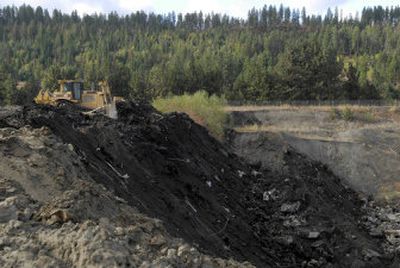
Stone’s firm, SRM Development of Spokane, is reclaiming the 80-acre site for a public park, housing and retail shops. During the excavation work, the company discovered an old dump site containing tree stumps and other woody debris.
The dump site is beneath part of the planned Riverstone Drive, a roadway that will wind through the Riverstone development. Contractors have been excavating the old dump site and moving the material to a new location on the property.
The woody debris isn’t appropriate to build on because it eventually decays and settles, Stone said. He’s using material dug from the old dump as fill for a green belt adjacent to the public park.
However, even moving the woody debris to a new location on-site might require regulatory approval.
Wood waste must be disposed of in an approved landfill, said Dick Martindale, Panhandle Health District’s environmental health section manager. “There are things being disposed of out there that shouldn’t be without a permit,” he said.
Inspectors for the Department of Environmental Quality and the health district visited the site Thursday morning after receiving an earlier tip that improper materials were being used to fill in a former gravel pit. Inspectors did not find any hazardous materials, but the disposal of the woody debris raised questions, Martindale said.
“We’re simply going to respond to a complaint,” he said, “and meet the appropriate parties on site to evaluate what actions, if any, are needed.”
Stone said reclamation of the site is an $8 million to $10 million undertaking, and he wouldn’t do anything to jeopardize the future ability to build on the ground. “We have a geotech (engineer) watching every shovelful of dirt,” he said.
The state Department of Lands issued a reclamation permit for the project, and Stone said he’d be surprised if additional permits are needed.
SRM Development is buying the former gravel quarry from Central Pre-Mix Concrete Co. in phases. Over a period of decades, most of the 80 acres has been mined for sand and gravel. The resulting pits were backfilled with a variety of materials, including topsoil, old concrete and construction debris and even wood waste from an old sawmill, said Mark Murphy, Central Pre-Mix’s president.
The challenge, according to Stone, is to turn the property into land suitable for building.
During test drilling, engineers discovered chunks of concrete, pieces of rebar and silty deposits with the consistency of Jell-O – remnants of settling ponds where dirt was rinsed from the gravel.
A massive earth-moving operation is under way to create stable building pads, said Eric Dix, a project engineer. The daily bill for the reclamation work is running about $15,000.
Sand is being imported to the site, and the silty deposits are being dried out and mixed with other materials. Even the concrete chunks have to be crushed to make suitable fill material, Dix said.
About 12 months of reclamation work remain, including filling the remaining pit area.
Central Pre-Mix stopped mining for gravel at the site last year. The company is still making concrete on the site but will eventually move those operations to another location in Kootenai County, Murphy said.