
Hope on Line 1
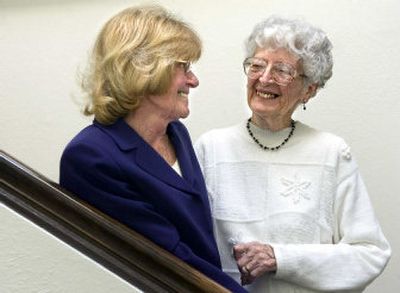
When you call Cece Glenn’s Spokane law office on a Monday, a Tuesday or a Thursday, you’re likely to find her 86-year-old mother, Hope Glenn, on the other end of the phone.
That’s because six years ago Cece, who handles primarily appeals and Social Security disabilities cases, hired her mother as her office manager. The two women, slender, smiling mirrors of each other, work together with affection and respect.
Together they tackle Cece’s last-chance cases while living out the values of Hope’s prairie upbringing. The words of Hope’s mother, and Cece’s grandmother, still resound in this office.
“Hopie,” she would say, “don’t worry about yesterday or tomorrow, just do the best you can and try to be kind.”
Hope Glenn wears soft white curls and on a recent day, a cream-colored suit and pearls. She keeps track of Cece’s cases in a steno notebook with perfect school-teacher penmanship.
A retired teacher and school administrator, she pursued a long, successful career that included helping to integrate the San Bernardino, Calif., school district and leading an effort to write the school’s K-12 syllabus and develop proficiency tests.
Hope rises at 6 a.m. and arrives at the office at 8. She listens warmly when Cece’s clients – many of them ailing, alone and living on as little as $339 a month – pour out their stories. In the evenings, she often cooks dinner, still making the baked pork chops and avocados Cece loved as a girl.
Cece left home at 17 to attend the University of California at Berkeley, and after she married and began raising children, she often lived at least two states away from her mother.
But over the years, Hope retired and Cece divorced. They mourned the loss of first Cece’s father and brother, and then Hope’s second husband. Finally, in 1999, Hope came to live in Spokane.
It was six years ago when Cece talked her mother into “temporarily” coming into the office to answer the phones and handle the files. She never got around to hiring anyone else.
“This was my absolute salvation,” Hope says, “and I just love it.”
The two women share similar features, though Cece’s hair falls to her shoulders in strawberry blond layers. She’s 63. They each speak softly and reluctantly about themselves, but warmly and effusively about others.
They’ve nursed each other through health scares – two rare forms of cancer for Hope and a neck-fusion surgery caused by degenerative disc disease for Cece – and moved into a South Hill home they share with Cece’s two show collies, Spice and Dilly, and Hope’s cat, Babe.
Neither of them voices any desire to retire.
Cece’s older brother, Franklin “Skip” Glenn, inspired her to enter law school. She had followed her mother into the teaching profession, but it was the premature death of her brother, a defense attorney who worked on some of California’s high-profile cases in the 1960s and ‘70s, that changed her career.
Skip Glenn defended a black activist in California who was charged with killing two white policemen. In 1979, Ben Bradlee Jr. wrote a book about the case, “The Ambush Murders,” and a television movie was based on it. The actor James Brolin portrayed Glenn’s character.
At that time, Cece was working at Spokane’s Peace and Justice Center, coordinating a defense committee to prevent a second trial for Yvonne Wanrow Swan, a member of the Colville tribe who shot a man to protect her son. Her brother’s influence, as well as her experience with Wanrow’s case, helped Cece decide to enter Gonzaga Law School in 1981.
“I remember someone said to me, ‘What are you doing? Trying to emulate your brother?’ I thought, ‘You’re doggoned right I am,’ ” Cece says.
Spokane defense attorney Pat Stiley hired her to work in his office, where her passion overrode her novice skills.
“The vibrancy of her soul and heart were so obvious to me,” Stiley says. “It took me about two minutes to decide to hire her, even though I knew I was never going to make any money on her.
“She would spend 4,000 hours on a case I’d spend an hour on,” he says. “Everything had to be perfect.”
He trained her to handle Social Security disability cases, and for the last 15 to 20 years, even after she opened her own office, he has referred all of them to her.
“She just took off in it because … she was representing the little guys against the powers that be,” Stiley says. “She became so good at it, I stopped doing it entirely.”
In the last decade, Stiley has also gotten to know Hope.
“It’s obvious where Cece and Skip got that heart,” Stiley says. “It’s written all over (Hope) every time you talk to her.”
Stiley imagines it’s difficult for Cece to actually make money practicing law.
“She doesn’t know how to tell someone, ‘Boy, you have to give me money now,’ ” Stiley says. “She just wants to help everybody.”
Over a plate of appetizers at Charley’s Grill near the courthouse one recent afternoon, Cece said, “It’s true.
“I’m certainly not destitute. I live a very comfortable life, even though the fees are somewhat minimal. … I guess I would rather have the cases than the money.”
A friend calls her “the champion of those who have no voice.”
“If I were running the world,” Cece says, “I would say everybody should have absolutely cost-free medical care, legal assistance and education.”
Cece’s clients, Carole Larsen and her son, Scott, adore both her and Hope.
Carole broke her back stepping out of the shower several years ago and was living on dwindling savings when Cece took her Social Security disability case. Cece pursued a similar case for Scott, who suffers from pancreatitis.
Scott Larsen calls Cece “a pitbull with lipstick.”
It took endless paperwork and over a year of delays and setbacks. Hope greeted them gently with hugs and hot coffee, and Cece kept plowing ahead.
“We’d do anything for them,” Carole Larsen says.
Once the cases were resolved, the Larsens each picked out a nice piece of crystal and some mints from Spokandy and took them to Hope and Cece.
“You would have thought it was Christmas six times over,” Carole Larsen says. “They just loved it. They’re more than your attorneys, they’re your friends.”
“I love my clients,” Cece says. “I know you’re not supposed to love your clients and I just do.”
Cece shares office space with Mark Vovos, her mentor in criminal law. She has been to the state Supreme Court three times, winning her first case there. It impacted inmates in Washington prisons and their right to a hearing before they lose time earned for good behavior.
Three years ago she took the case of Sharon Curry, who had been acquitted of the murder of her daughter by reason of insanity and committed to Eastern State Hospital. Cece believed in Curry, and found experts who testified that it was a dose of the attention-deficit-disorder drug Adderall which led to Curry’s violent behavior.
Curry’s out of the hospital now, on very strict conditions.
“She’s a productive, high-energy woman who lives with the loss of her daughter every day,” Cece says. “That case means a lot to me because I foresee her being a very productive individual in the future.”
Through each of these cases, Hope keeps the paperwork, the appointments and the court schedules on track. The difficult lives of the clients remind her of her family’s blessings – and its values of love, caring and patience.
“We’ve never had a lot of money, and we never will,” Hope says. “That’s not where it is.”
She’s made Cece promise that when the day comes that she’s no longer able to handle the job, her daughter will be honest.
In the meantime, says Carole Larsen, “Hope is what keeps that place running.”