
Smoke on the water at the USO
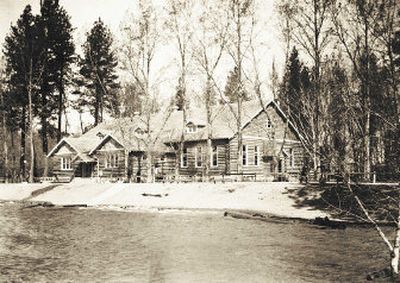
The big USO Club in Coeur d’Alene’s City Park was one of the swingin’-est, jitterbuggin’-est spots in the Inland Northwest during World War II. Until a 17-year-old sailor burned the place down on Oct. 10, 1945. Up in smoke went a beachfront haven remembered fondly by hundreds of thousands of servicemen and women. Their precious leave time had been spent within those log walls. Some were soldiers from Geiger Field and Fort George Wright, but by far the majority were sailors from Farragut Naval Training Station on Lake Pend Oreille. Farragut was one of the country’s biggest naval training camps, and about 300,000 recruits went through Farragut between 1942 and 1946. Most of them probably paid at least one visit to the Coeur d’Alene USO.
Fifty years later, former recruit Clyde Roberts recalled exactly two things about his one and only trip off-base: eating a hamburger at Hudson’s and hanging out in “that USO building in the park.”
The building did not begin as a USO Club. It was built by the Works Progress Administration in 1937 as Coeur d’Alene’s Civic Auditorium, according to Dorothy Dahlgren, director of the Museum of North Idaho.
It contained a spacious open room, suitable for gatherings, concerts, shows and dances. With the war raging in 1942, it was converted to a USO Club to serve the sailors and soldiers already rolling into the area. By October 1945, a Coeur d’Alene USO official estimated that a staggering (and maybe inflated) 1,750,000 visitors had registered in the club’s guest book. Even though the war was over, new recruits were still pouring in.
Then, after midnight one fall night, firefighters were called to a trio of suspicious car fires a block from the club. While there, they saw fire inside the building. Before long, flames were shooting 75 feet into the air.
The USO Club had already closed for the night; nobody was inside and the fire did not spread to any other buildings. Firefighters fought the blaze for eight hours but were unable to save the structure.
“Only a pile of hot coals and charred logs remained,” reported the Spokane Daily Chronicle.
Firefighters immediately suspected what they called “a firebug.” Five days later, the Coeur d’Alene police chief announced that William Barna, 17, a Farragut recruit from New Jersey, had confessed to the arson.
The Navy’s shore patrol had brought Barna in for questioning and after 20 minutes, he broke down. He later led the police and fire chiefs to the ruins and demonstrated how he had first started the car fires and then ran to the USO Club, where he hid in the ladies’ restroom while the manager locked up. Then he set fire to some curtains and part of the stage.
Speculation was rampant that he held a grudge against the USO or somebody at the club. Yet when Barna was sentenced to five to 10 years of hard labor, he signed a confession in which he claimed he held no grudge against the USO “or anyone else” and did not know why he set the fire.
He was simply, according to the judge, a pyromaniac.
There was talk of rebuilding, but with the war over and the need dwindling, nothing came of it. However, if you want to get an idea what the old building looked like, head north to Sandpoint.
The WPA had built a sister log building in Sandpoint. It, too, was converted to a USO Club in 1942. It’s now the Sandpoint Community Hall, 204 S. First Ave., near the bridge entrance to town.