
Morning-after pill program in Chile begins, with clash

SANTIAGO, Chile – Chile began supplying morning-after pills to girls as young as 14 this week under a program that has created an uproar in the politically leftist but socially conservative country, which still outlaws all abortions and only legalized divorce two years ago.
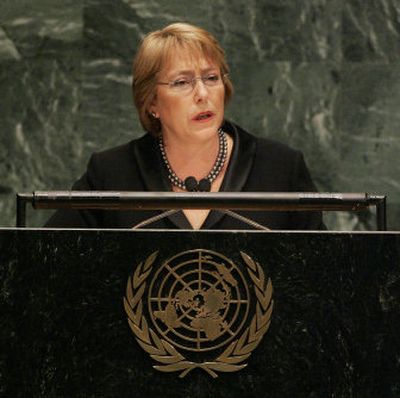
The liberalized contraceptive policy is close to the heart of President Michelle Bachelet, a socialist physician who took office as Chile’s first female president in March vowing to promote equality between men and women.
“Equality means that for a person who does not have choices, who does not have options, we have to give them these options,” Bachelet told the Associated Press at the United Nations last week.
It also echoes a debate between reformers and conservatives across Latin America, where the Roman Catholic Church is a powerful force.
The program provides contraceptives – including the morning-after pill – to girls as young as 14 without notifying their parents. Until now, the age limit was 16, and the morning-after pill was given only to women who had been raped.
The government began handing out the pills this week after an appeals court lifted an injunction won by two conservative mayors and a Catholic parents association. Pablo Zalaquet, mayor of the middle-class Santiago suburb of La Florida, called Friday’s ruling “a slap in the face of Chile’s mothers and fathers” and said the court battle would continue.
Health Minister Maria Soledad Barria said free contraceptives would help reduce adolescent pregnancy, especially among the poor. Her ministry says women age 15 to 19 account for 17 percent of pregnancies nationwide and estimates that 32,000 women go to hospitals each year for complications from abortions, which are illegal in Chile.
The Catholic parents association says contraceptives encourage sexual promiscuity and sexually transmitted diseases among youths, and Catholic high school students protested in the capital, carrying balloons and Chilean flags.
But many younger Chileans say their parents’ generation is out of touch – and that teenagers need medical support because they’re already having sex.
“I would not use it, but I think it is a good idea to make it available at age 14, and without telling the parents,” high school student Maria Jose Guzman said. “Many girls … would be ashamed to tell them they had sex.”
The morning-after pill contains the hormone levonorgestrel and prevents pregnancy by inhibiting ovulation or fertilization of an egg. To be effective, it must be taken within 72 hours of intercourse.
Religious leaders compare the pill to abortion and say it violates the right to life. A statement by Chile’s Catholic bishops equates the program to “policies imposed by totalitarian regimes to establish state control over the intimate lives of citizens.”
Despite Friday’s court ruling, Mayor Marta Ehlers of Lo Barnechea, an upper-class district in Santiago, said her municipality will not implement the program, “even if it means that I have to go to jail.”
Until now, Chile has been considered a socially conservative nation. Seventy-five percent of the population calls itself Catholic and divorce became legal only in 2004.
The morning-after pill became legal in Chile in 2002 after a Supreme Court battle.