
Abused by drugs
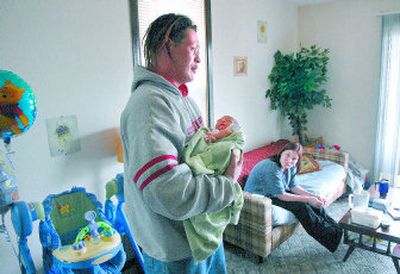
In a hospital bed in February, Dejah Bridges fought the most natural urge: to give birth to her child. The 24-year-old recovering drug addict said she resisted the waves of contractions. Though a doctor and nurse hovered nearby, it was the prospect of Washington social workers waiting for her son’s birth that terrified her.
“I knew they were going to take him,” she said.
For Bridges and her husband, Christopher, it was a familiar arc. Three of their children had already been placed in foster care as the couple struggled with drugs and homelessness.
But this time, they believe it will be different.
“We can’t live that life anymore,” said Christopher Bridges, 28. “Drugs take everything from you.”
Parents with a history of drug and alcohol abuse present one of the oldest and most challenging situations for the child welfare system.
Nationally, between one-third and two-thirds of all child maltreatment cases involve substance abuse, according to the U.S. Department of Health and Human Services. States spend more than $5 billion to address the burgeoning number of children from drug-affected families in the child welfare system, according to a 2001 study.
The troubling link between substance abuse and child maltreatment is particularly severe in the Inland Northwest, child welfare officials say.
In Idaho, the number of children placed in foster care doubled in the past decade, driven by an explosion in methamphetamine use. These children, say experts, typically spend more time in the foster care system, driving up expenses as their parents attempt to become sober.
“We are seeing such an increase in substance abuse,” said Karen Cotton, regional director of the Idaho Department of Health and Welfare. “These kids are left unattended, or the parents are not feeding them, or clothing them or just keeping them safe.”
Cotton estimates that substance abuse was a factor in 80 percent of cases where children were put into protective custody. The Washington attorney general’s office estimates a similar percentage in Eastern Washington.
Not only are these children more likely to struggle in school or abuse drugs or alcohol themselves, they also face riskier home lives. In a review of 87 child fatalities published last year, Washington’s children and families ombudsman found that two-thirds of the children who died came from homes with histories of drug and alcohol abuse.
In recent years, both Washington and Idaho have attempted to help drug-abusing parents. Two years ago, Washington added 22 new chemical dependency counselors to work within its child welfare system and help reunify families. Idaho has added training for its foster parents to help them understand the drug problems facing families.
The extent of the damage done to children of drug addicts and alcoholics can be hidden. Children often suffer in relative obscurity, languishing in the care of neglectful parents who fail to provide basic necessities.
Flies emerging from a refrigerator, soiled mattresses without sheets and car parts leaking oil in the middle of a living room are just a few examples of what law enforcement authorities in Spokane County and North Idaho have encountered during drug investigations over the past two years.
“We investigated a marijuana grow this year in Deer Park, on Feb. 1, where the feces and filth were so bad in the home that the detectives had to wipe their feet off when they came out, but the room where the marijuana was being grown was pristine,” said Spokane Valley Police Chief Rick VanLeuven, who was the lieutenant in charge of drug investigations until last month.
“You get the impression they are more concerned with taking care of their drugs than their three kids.”
A crisis driven by drugs
The horror stories are numbing: In the Spokane Valley, police found crack cocaine in a cereal box. At a mobile home, they found hypodermic needles inside a baby’s bassinet. City police recently found drugs on a countertop near an open package of cookies.
“Leaving drugs on a table or within reach of a child is as normal to dopers as putting a TV remote on the footstool to other people,” VanLeuven said.
Authorities throughout the region agree that methamphetamine is the most common drug they see in cases that result in removing a child from a home.
“About four years ago, Spokane was a manufacturing site for methamphetamine,” said Linda Thompson, executive director of the Greater Spokane Substance Abuse Council.
Through the council’s work with legislators and businesses, the chemicals needed to make meth were made less available and law enforcement was able to knock out existing labs in the Spokane area.
“Now we are a distribution point for meth,” Thompson said.
The shift means that children in meth homes are more likely to be harmed by neglect than by the chemicals used to make the drug.
Meth use in Spokane was much higher than the national median in 2003 – the most recent year statistics were available – and substantially higher than in Seattle, according to a study by the U.S. Department of Justice. That year, 32 percent of men arrested in Spokane County tested positive for meth, compared with 12 percent in Seattle and a national median of about 5 percent. In Idaho, 52 percent of inmates were incarcerated for meth-related crimes, according to the Idaho Meth Project, a newly formed meth-prevention effort.
Idaho State Police Capt. Clark Rollins said one of the worst cases of neglect he’s seen involved a preschool-age girl whose mother had a meth lab in the bathroom she shared with her daughter.
When detectives kicked down the home’s front door to serve a search warrant, the mother was out on a drug run and the “baby sitter” was passed out in a chair. The girl had no food, no supervision and the home was filthy, Rollins said.
A plate of meth was found on the bed the girl shared with her mother and there were syringes on the floor. The girl tested positive for the drug.
“Developmentally, she was very far behind both physically and mentally,” Rollins said. “She should have been speaking, but she wasn’t able to speak and she had detachment disorder. Any attention at all and this little girl would just glom on to you.”
Rollins said the girl was removed from her mother’s custody and now lives in another state with her father.
“Almost all the cases we’ve reviewed involve some form of chemical dependency,” noted Toni Lodge, a member of the Local Indian Child Welfare Advisory Committee, a body established by federal law to advise on Indian child welfare cases. Alcohol and marijuana “still reign,” she said, but “many of the recent cases have been methamphetamine.” Lodge is also director of the NATIVE Project, which provides mental health and substance abuse services, and has worked for 25 years on a child protection team that reviews some child abuse cases in Spokane.
In Spokane and Kootenai counties, law enforcement removed more than 150 children last year – the majority from drug homes.
“If children were exposed to hazardous situations, deplorable living conditions and/or access to drugs and firearms, they are removed from the home,” VanLeuven said.
In addition to living amid dangerous and filthy conditions, there are also children who are forced to meet their own basic needs such as food and shelter. VanLeuven remembered a case in which detectives came upon two kids selling lemonade from dog bowls to make lunch money.
“A parent on meth or a parent on drugs is not a good parent,” he said.
But not all parents with drug addiction problems are doomed to fail. Some addicts react to losing a child as if they’ve hit rock bottom, and it’s the necessary wake-up call to straighten them out.
The volunteer teams, which assist Washington state’s Children’s Administration, are made up of community professionals such as Lodge, teachers, law enforcement representatives, corrections officers and psychologists, said Nicole LaBelle, regional program supervisor for the state agency. The 10 to 13 team members help the agency with decisions in cases where a child’s home environment is considered moderate to high risk. The cases can include sexual abuse, physical abuse and neglect – the most common form of maltreatment among drug abusers with children, experts say.
Kootenai County authorities placed 77 children with Child Protective Services last year and about two-thirds of those involved drug or substance abuse, Kootenai County Prosecutor Bill Douglas said.
In Spokane, 75 children were put into protective custody by county law enforcement, slightly less than the previous year, when nearly 100 kids were pulled from houses where drugs were a factor.
Spokane authorities have removed about 100 children per year since 2002.
Struggling for sobriety
For Christopher and Dejah Bridges, the battle with drugs has been long and costly. Last fall, the couple lived under the arches of the Maple Street Bridge, huddling beneath a mass of blankets as Dejah’s pregnancy progressed.
Night after night, homeless people high on meth wandered through their camp. Friends offered them joints or hits. But with Dejah pregnant, the couple say they stayed clean.
They found faith on the streets, under the ministry of a man named Pastor Cowboy and a Christian outreach group. The couple began to submit to regular urine analyses to prove their sobriety to the state’s Child Protective Services.
For the time being, the Bridges’ story has had a happy ending.
After holding the infant in foster care for a week, Washington officials returned the baby to the couple, who were sponsored by Christian leaders from Off-Broadway Family Outreach, a West Central ministry.
“We’re really optimistic over their progress,” said Larry Whiston Sr., a ministry leader. “I’m pretty sure they have made it out.”
The couple found a clean apartment in a neighborhood in West Central. Christopher Bridges completed a one-month inpatient drug program.
But the West Central neighborhood has long memories. Just blocks from the apartment, the Bridges had routinely scored meth and marijuana at some of the most prolific drug houses in the city.
“We have to get our lives straight,” Christopher said, rocking his son in his arms. “For him.”