
Club for all kids

In the heart of the East Central neighborhood, on a sunny spring afternoon, a small boy energetically swept the sidewalk in front of the Boys and Girls Club. He’s typical of the children who come here each day. They take pride in having a place that’s just for them.
Established in 2001, the club is designed to be a safe place for children ages 6 to 18, during the critical after-school hours.
“We are not a daycare,” said Ryan Davenport, executive director. “We’re a club in the literal sense of the word.” For $10 per year, children can participate in the many daily activities offered, in a well-supervised, structured environment.
The enticing smell of beef stew wafted through the large activity room of the former St. Francis Xavier School. Davenport said the club began offering children a substantial snack a couple of years ago. They’d discovered the only healthy meal many of their members ate each day was at school.
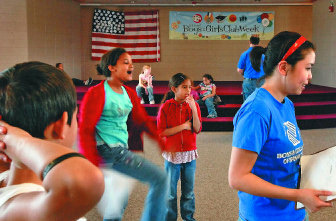
The students and staff gather twice a day for a big assembly. On a recent afternoon, activities director Ryan Rodriguez outlined the various options for kids to choose from. At the end of the assembly, Rodriguez shouted, “What’s life about?” The kids thunderously replied, “Choices!”
And that’s exactly what Davenport sees as the vital imperative of Boys and Girls Club. “We want to guide children into making good choices,” he said. “There are no bad kids, just bad choices.” He believes the key to accomplishing this is the relationship between the children and staff. They interact by playing games together or reading books or just chatting about their days.
After the assembly, the excited kids scattered. Some waited in line for beef stew, some surrounded the foosball and pool tables that filled the activity room. The average attendance at the club is 140 children per day, with 7- to 12-year-olds making up the bulk of the membership.
In the upstairs technology center, a half-dozen kids sat in front of computer screens. They can choose from a variety of educational computer games or they can learn how to design their own. Internet access is available but club members must complete the Net Smart safety class before using it.
Across the hall, sun poured through the windows of the library. Warm terra cotta-colored walls lined with bookshelves make this an inviting space. Two book clubs meet here each week.
The art room is filled with every art supply imaginable, from acrylic paints to clay. This room is supervised by a third-year art major from Gonzaga University. The club employs four full-time and 18 part-time staffers. Most of the part-time staff are GU or Whitworth students.
“Education is a huge focus for us,” Davenport said. In the discovery center one hour of homework supervision is offered daily. Called, the “Power Hour,” it’s designed to help students meet their educational goals. Kids are given stickers for every hour of homework completed, and those stickers are redeemable for prizes. “A large percentage of our kids don’t have anyone at home saying, ‘Did you get your homework done?’ ” said Davenport. “We want to do that for our kids.”
Hoopfest recently donated an outdoor basketball court. “Before this we didn’t have a place outside for kids to play,” Davenport said. “It was all weeds and dirt.”
The next project they hope to tackle is a complete remodel of the old gymnasium. The ramshackle room was filled with happy kids engaged in a game of kickball, but the wear and tear was obvious in the dented, decrepit paneling and scuffed-up floor. Seven-year-old Desirae Chaney hustled through the door. “Kickball’s my favorite!” she said.
Aaron Hehl met up with Davenport in the hallway. The serious, dark-eyed 10-year-old is working on an unlikely goal. “I’m going to start a comedy club here,” he said. He’s already recruiting friends to join. Davenport is proud of Hehl’s accomplishments. “Aaron had some anger issues,” he said. “But we worked on them and he’s doing really well.” When asked how to handle anger, Aaron replied, “We don’t yell. We just try to talk and not yell.”
Boys and Girls Club offers children a place to discover positive self-identity and a moral compass as well as educational and social skills. This was apparent when 9-year-old Octaysia Ross tracked Davenport down. “Can I help you work?” she offered. She grew animated as she talked about the club. Her eyes shone as she said, “I come here every day! I want to work here when I get older.”