
Iran hails nuclear capacity advance
NATANZ, Iran – Iran’s announcement Monday that it had achieved the capacity to enrich uranium on an “industrial scale” raises the fear that the Islamic Republic could manufacture a nuclear weapon within a year but was met with deep skepticism from nuclear experts.
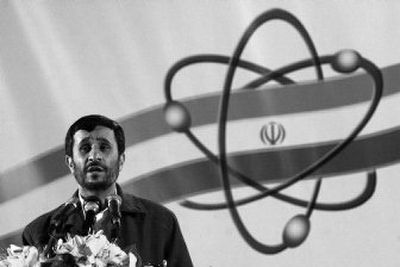
President Mahmoud Ahmadinejad, speaking at an annual commemoration of his nation’s nuclear program, described Iran as an established nuclear power.
“Iran is on the way to greatness, and nothing can stand in its way,” he told the crowd of 500 dignitaries, which included representatives from at least 45 foreign countries.
But Iran’s claim, including an assertion that it had fed gaseous uranium into 3,000 centrifuges to begin purifying nuclear material on an industrial scale, was refuted by many experts and officials.
Independent experts largely portrayed the Iranian claim as a political statement designed to bolster its international and domestic stature, rather than an indication that Tehran has reached a significant new milestone in its nuclear program.
A White House spokesman said the Bush administration was “very concerned” about the nuclear program. “Iran continues to defy the international community and further isolate itself by expanding its nuclear program, rather than suspending uranium enrichment,” said Gordon Johndroe.
By presenting enrichment as an accomplished fact, Ahmadinejad can step back from his defiant statements and force a new starting point to negotiations with the West, analysts said.
“It’s very clever,” said George Perkovich, head of the non-proliferation program at the Carnegie Endowment for International Peace, a Washington-based think tank. “They’re keeping their options open. They’re saying, ‘We’ve defied everyone. We’ve done it.’ They’re declaring victory. … That way they can suspend later and come into compliance. Or they can blast forward.”
Asked by reporters whether all 3,000 centrifuges had been injected with uranium gas, nuclear negotiator Ali Larijani replied, “Yes.” The oblique manner in which the milestone was made public raised suspicions about its veracity.
Few outside experts believe Iran has successfully installed and is operating such a large system. Western experts suggest Iran has no more than 1,000 such devices, which it can operate only part time. An IAEA report in February said Iran was able to operate about 328 centrifuges.
“Most people believe they have not mastered enrichment technology,” said Matthew Bunn, a nuclear expert at Harvard University. “Nothing we heard today changes that.”
Iranian officials said it would be a few weeks before the number of centrifuges would be disclosed.
But Gholam-Reza Aghazadeh, head of Iran’s Atomic Energy Agency, also said that Iran has “entered the phase of mass manufacturing of centrifuges,” which could indicate that Iran’s nuclear program is growing on several fronts.
Under the international nuclear Non-Proliferation Treaty to which Tehran is a signatory, Iran has the right to produce enriched nuclear material provided its activities remain under the observation of international inspectors and don’t veer into a weapons program. But many international nuclear inspectors suspect Iran is exploiting loopholes to acquire nuclear weapons capability.