
Mural will remain
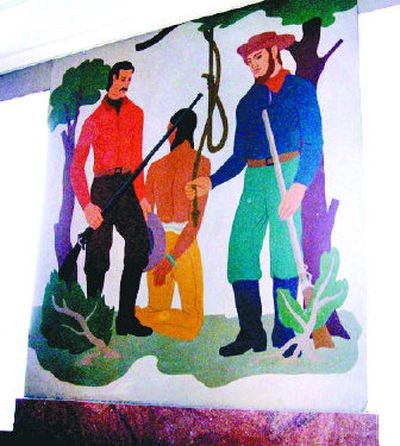

BOISE – Despite recommendations that a controversial mural showing the lynching of an American Indian should be moved, covered up or explained with an interpretive plaque, a legislative task force has decided to leave the historic mural on display in a building where state offices are opening.
State workers moved into the old courthouse this week, and the next legislative session will be held there, beginning in January. Mike Nugent, manager of research and legislation for the state Legislative Services Office, said no one had asked him about the murals yet, but he’d only been working in the building for a few days.
“We haven’t had a whole lot of foot traffic yet,” Nugent said.
Legislative library assistant Mark Robertson, who was hauling empty cardboard boxes down from the library’s new quarters on an upper floor of the old courthouse, said he walked right by the murals several times without noticing them. “I had to be told about them,” he said sheepishly.
The crudely drawn 1930s murals were a Works Progress Administration project that put Los Angeles artists to work during the Depression drawing murals intended to depict the Boise area’s history. They have gotten plenty of negative notice over the years.
When the building was still the Ada County Courthouse, then-District Judge Gerald Schroeder ordered that two murals that depict a lynching be covered with Idaho and U.S. flags. Schroeder is now the chief justice of the Idaho Supreme Court.
During this year’s legislative session, the Idaho Indian Affairs Council, which includes lawmakers and tribal leaders, toured the courthouse and viewed the murals to get input from tribes. Tribal officials favored preserving the murals, but doing it elsewhere – not in the prominent location in the courthouse. Alternately, they recommended interpretive plaques, written with tribal input, to explain the context of the images, which don’t depict any historical event.
“It was very clear what the tribes wanted,” said Sen. Mike Jorgenson, R-Hayden Lake, chairman of the Indian Affairs Council. “They absolutely wanted the paintings preserved and taken down.”
However, Jorgenson said, “It was determined that the paintings could be damaged because even though they’re on some sort of a canvas, they’re cemented to the wall. So it was suggested … that they be preserved in place.”
The idea developed by the state Department of Administration was to cover the murals with protective layers, then build a false wall in front of them to hide them for now.
But when Keith Johnson, director of the department, recommended that in late January, a legislative committee overseeing the move from the state Capitol into the courthouse rejected the idea. That decision still could be revisited before next year’s legislative session.
Rep. George Sayler, D-Coeur d’Alene, said, “I’m disappointed in that, yet I’m not too surprised. The Legislature has not been the most sensitive toward Native American issues here anyway – the gas tax issue is a good example. I’m disappointed that they won’t at least cover them or put up the plaques, do something to at least show some sensitivity toward their concerns.”
Sayler, who serves on the Indian Affairs Council, said, “We’ve tried hard to give that council more credibility, but I don’t know if we’re getting anywhere sometimes.”
Senate Majority Leader Bart Davis, R-Idaho Falls, who serves on the legislative committee on relocation, said he favors covering the offending murals. “I’m not a fan of them staying the way they currently are,” he said.
House Assistant Majority Leader Scott Bedke, R-Oakley, said, “There was no push one way or another to do anything with the murals. If the tribes wanted ‘em covered, we would’ve covered ‘em, and in the absence of that, I think we just left them the way they were, knowing that we could come back to that decision.”
He added, “I know that the last thing the committee wanted to do was perpetuate something that was offensive.”
Jorgenson said he thought there might have been a miscommunication, and said he hopes the murals will be covered before lawmakers convene their session next January.
One of the murals shows armed white settlers accosting a Native American man. Another shows the settlers preparing to hang the man, who’s on his knees before a noose dangling from a tree.
Jeff Youtz, state legislative services director, said, “The advisory committee voted to just leave the murals up, and we have moved in here, and they’re still up.”
Johnson said, “There is no immediate plan to cover them up or to hide them.” But he added, “My preference would be to cover them up.”