
Other Land Down Under
It’s tough to find “American” coffee in New Zealand.
When I asked a barista for a cup of black with room for cream, she told me I was ordering “coffee Vienna.”
It turned out to be a very stout black with whipped cream floating on top. Not quite what I’d envisioned.
One of our hosts suggested that I should order “filtered coffee.” That worked out for about a quarter of my orders.
Ah well, travel is supposed to be broadening. I learned to drink several blends favored by the kiwis, including flat white, long black and cafe Americano.
By the way, despite the name, the latter is not any coffee that I’ve slurped in this hemisphere. It’s European: espresso with hot water, and darned strong.
My wife and I have just returned from three weeks on the beautiful green islands nation down under, half a world away in terms of distance and nearly the same distance in terms of style and outlook.
We were very fortunate in that we have kiwi friends who took us under their (figurative) wings.
I became acquainted with the New Zealand Surgical Team 42 years ago when I was stationed in Qui Nhon, a small coastal Vietnamese city. The physicians and nurses were civilian volunteers, there to patch up wounded Vietnamese civilians.
I’d lost contact with them in the years since returning from the war, but 10 years ago a retiring airline pilot pal gave me a pass that I used to fly to their homeland. A bit of investigating in the New Zealand medical community and I found the survivors.
The physicians who’d been in their 40s and 50s during their Vietnam service, were dead, but a pair of nurses who – like me – had been in their late 20s during the war were living in New Zealand’s largest city, Auckland.
We had a grand reunion and since then have kept in touch via e-mail. One of those nurses, Rae Lalande, visited us five years ago. She and my wife, Sally, a hospice nurse, hit it off, and both Rae and her fellow Vietnam vet nurse, Faye Langton have been bugging us to visit them ever since.
After brief stops in Fiji and Auckland, we arrived in Christchurch on the nation’s south island where our tour began.
Their currency is, like ours, on the decimal system, so it was relatively easy to convert kiwi dollars – worth about 72 U.S. cents – to ours, so I’ll use American currency throughout this narrative.
A two-night stay in Christchurch was $130 in a clean and decently appointed hotel room, a 15-minute stroll from the city’s center. An adjoining restaurant cum tavern offered Three-Star Pie, with venison, mushrooms, a beer sauté in a pastry shell for $9, and their dark ale complemented it perfectly.
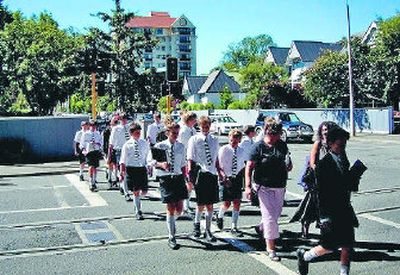
Christchurch, a provincial center of some 350,000, is flat, and its parks, town square, municipal gardens, craft shops, cathedral and museums invite walkers.
But if you get tired of walking, a two-day pass on antique streetcars that wind through downtown costs $9, and you can hop off at a dozen stops.
The next leg was via Rail New Zealand, a two-day land and sea trip that cost $173 each.
Our journey began with an eight-hour rail trip, then a sail on a giant ferry that took us on a three-hour voyage to the north island and the nation’s capital, Wellington.
We stayed two nights in a clean room in a 101-year-old hotel that cost $60 a night, and it too was just a 15-minute hike from the center of that very windy city.
A cable car to the top of the city dropped us at a museum and a nearby observatory in the city’s botanic gardens. And a two hour stroll through ferns, flowers and exotic southern hemisphere flora brought us back to town through Wellington’s 19th Century pioneer cemetery.
When we resumed our train voyage, we learned that a truck accident the day before had badly damaged a bridge over which the train had to pass. So, we rode the rails for several hours, transferred to a bus that circumvented the damaged bridge, then entrained again at National Park.
Our friend Rae met us in Hamilton and took us on a beautiful mountain drive to her home in Whitianga, a charming town of some 3,500 on scenic Mercury Bay.
The site of one of British Capt. James Cook’s landings and explorations, the former timber and mining town is now a popular tourist destination, famed for boating and fishing.
Our sport, however, is golf, and we managed to get in a couple of rounds on the municipal course, one of them a best-ball benefit for the local ambulance company.
Every merchant in town, it seemed, donated prizes, and even though our team came in dead last, tournament officials made sure that we, their American guests, were rewarded. Me with a lined and oil-impregnated stockman’s vest, my wife with an insulated bag.
One of Rae’s friends was celebrating her 40th birthday so we were invited to join the festivities at a “dress for the ‘70s” party. A visit to a thrift shop took care of the costumes, including a Fijian shirt and “gold” chains for me, and a sexy shift for my wife.
I went equipped with a camera, explaining to fellow guests that we would tell our American friends that their clothes were the latest New Zealand fashions.
Rae treated us to a flightseeing tour of the area, including an overflight of locations for the “Chronicles of Narnia” motion picture.
She then delivered us to the Langtons who live in Wattle Downs, an Auckland suburb designed for retirees. We didn’t stay there long, but journeyed north by road to the incredibly scenic Bay of Islands and New Zealand’s first capital, Russell.
There we stayed in the charming Villa Du Fresne, named for an 18th-century French explorer of the area. The villa is a bed and breakfast with a difference: You furnish your own food, but the appliances, dishes and utensils are provided.
We explored the area on land and water for three days, then headed back for Wattle Downs with a side trip to the extremely well-appointed Kauri Museum, dedicated to the islands’ forestry industry and its pioneers.
Our visit concluded with three days of Auckland area tours, conducted by the Langtons and on our own, where we stocked up on souvenirs and gifts to prove we’d been there.
A 12-hour flight from Auckland to Los Angeles brought us home to America.