
Long day’s journey into ‘Dusk’
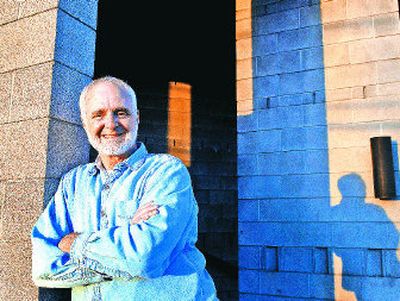
Year after year, play after play, Spokane’s Bryan Harnetiaux has created a record to make any playwright proud.
Harnetiaux, 59, a lawyer by profession and the Spokane Civic Theatre’s playwright in residence for 25 years, has written 30 plays. Of those, 11 have been published nationally.
Several, including “Vesta,” have been performed in dozens of productions all over the U.S. “National Pastime,” his dramatization of the Jackie Robinson story, has had extended runs in Pasadena, Calif., and Stamford, Conn.
And this weekend, his newest play, “Dusk,” has its premiere at the Spokane Civic Theatre’s Firth Chew Studio Theatre.
“One of the themes I have continually come back to, for whatever reason, is mortality and death,” said Harnetiaux.
“I wanted to tell the story of a 64-year-old man dealing with the aftermath of a heart attack. He’s part of the vanguard of the boomers, coming up on 65. This is about his reckoning with that.”
The main character, Gil, is asked to decide whether, next time, he wants life-saving medical intervention.
So the title “Dusk” may be a metaphor for another kind of ending.
“I love that word, ‘dusk,’ ” said Harnetiaux. “I pulled it out of the ‘Love Song of J. Alfred Prufrock.’
“That word is loaded for me. I don’t think it’s death. It’s that lovely time of the day when things are in the process of going dark. There’s something both lovely and terrifying about it.”
Diana Trotter directs a cast that includes Nik Adams (as Gil), Brooke Kiener, Sara Nicholls, Benjamin Lee and Maxwell Nightser.
Harnetiaux has been involved in the rehearsal process from the beginning.
“You hear it said that most directors like working with dead playwrights,” said Harnetiaux. “But Diana has totally given herself over to this.”
One of the happy side effects of having a playwright-in-residence is that it gives the cast and director the intensely collaborative experience of helping shape a new work. Instead of accepting a script as inviolable, they can help but show the author what works and what doesn’t.
Harnetiaux made major revisions to the work after a staged reading at his home. He has continued to make revisions during the rehearsal process.
“No major upheavals, but some nice finish work during the rehearsal process,” he said.
It’s an artistic process that Harnetiaux has cherished from the beginning.
A native of Pasadena, Calif., he came to Gonzaga University in 1965 and graduated from Gonzaga Law School in 1973. He began working with the Civic as an actor, but soon, through his participation in the theater’s play-reading committee, he developed a “hunger to write.”
His first one-act was titled “Caution: The Surgeon General Has Determined …,” about a man trying to quit smoking. He calls it “a fairly light comedy, but a good place to start.”
Harnetiaux wrote several other one-acts. Then, in 1980, the Civic produced his first full-length play, “Dumb Luck,” on the Main Stage.
United Press International’s theater critic even came out from New York to review it – and tear it into tiny pieces.
“He shredded it,” said Harnetiaux. “It was merciless. I was just devastated.”
Yet Harnetiaux took many of his suggestions – as well as those from an editor at Dramatic Publishing, a major theatrical publisher – and cut and revised the play dramatically. Dramatic Publishing printed the revised version and it is still available in their catalog.
“God bless the Civic for taking a chance,” said Harnetiaux.
In 1982, the year the downstairs Studio Theatre began offering a full season, Harnetiaux became the Civic’s playwright-in-residence.
“Betty Tomlinson (the Civic’s late executive director) could see I wasn’t going to go away as a writer,” he said. “She could see the value in having a writer-in-residence.
“It was just a handshake agreement. They would have the right of first refusal of anything I did, and I wouldn’t go anywhere else. And that’s the way it still is.”
He has averaged about a play a year since, most of them premiering in the Studio Theatre. One of the most successful – and still one of his favorites – is 1996’s “Vesta,” about an elderly woman facing end-of-life issues. It has been performed more than 50 times, often as a staged reading at conferences.
“If there are two things I tend to write about, it’s mortality and social justice issues,” said Harnetiaux.
Yet the play closest to his heart is 1998’s “National Pastime,” which has given him “nothing but exhilaration and heartbreak.”
Exhilaration, because this story about baseball legend Jackie Robinson, who also grew up in Pasadena, has received two high-profile professional productions. It had an extended run in 2005 and 2006 at the Fremont Centre Theatre in Pasadena and then at the acclaimed Stamford Theatre Works in Connecticut.
Heartbreak, because the play still hasn’t been published and it never made that crucial 11-mile leap from Stamford to New York.
“It was a good show, and I hoped that somebody would pick it up,” said Harnetiaux. “But it didn’t happen.”
Yet Harnetiaux certainly doesn’t need to count on his play royalties to pay the bills. He has a well-established law practice doing appellate work for the Washington State Trial Lawyers Association.
“My practice consists of writing briefs and appearing before the Washington Supreme Court for this organization,” he said. “I would say it’s less than full-time, but it’s still quite time-consuming. The law must come first.”
These two professions – while seemingly mismatched – are actually a serendipitous combination.
“I’m using both sides of my brain,” said Harnetiaux. “The law is very cerebral, very rational. This keeps me healthy.”
.