
Healing waters
SANDPOINT – Every swimmer has a story.
Some compete to swim faster than anyone else in their age or gender group. Many try to beat their personal best times. Some just hope they can swim the 1.76-mile distance in less than the 2 ½ hours allotted. Others just want to be part of what many consider the Northwest’s premier open-water swimming event.
The Sandpoint tradition known as the Long Bridge Swim provides a unique challenge for participants, and all address it on their own terms.
For Louise Zamparutti, of Seattle, who will be swimming it for the first time Saturday, it will be a celebration of swimming as a familiar activity – one that became her passion only when all other physical activities, and even life, seemed to fail her.
Zamparutti once biked everywhere in her hilly hometown. She taught dancing and yoga as well, stringing together freelance jobs to make a living.
Everything changed on Jan. 9, 2001, when a drunken driver hit her as she biked home on Seattle’s Capitol Hill. Zamparutti doesn’t remember the details, only that someone drove her home.
“I couldn’t do anything for a week and a half,” she said.
Although she hurt in a lot of places, her left hip continued to ache the most.
But as the shock and pain receded, Zamparutti grew tired of lying on her couch waiting to get better. She got back to making a living. But over the next 18 months, she found it hard to walk.
“I became more and more disabled,” she said. “I used a cane, I limped, I hobbled. Everything was painful. Walking, sitting and lying down were all painful.”
Zamparutti continued to teach yoga but had to modify her moves, do more telling than showing. Eventually she gave up even that. Dancing went by the wayside. She wondered if she’d be able to support herself.
Then she was asked to teach swimming. Zamparutti wasn’t excited at first, but she needed work – and could swim in her disabled state. As she began to teach, she discovered she wanted to swim more.
“I could swim 2.5 miles a day and have an hour and a half of peace and a break from pain,” she said.
But Zamparutti said she remained despondent. “I didn’t think I’d ever live a normal life again. I was 35 years old, and I kinda figured I was at the end of my life.”
In August 2002, after 19 months of continuous pain, she was referred to a hip surgeon, who discovered her hip was “completely destroyed,” she said. “There was no cartilage, and the bone structure had changed completely.”
Her surgeon suggested a total hip replacement. Zamparutti worried she would have no means of supporting herself during the lengthy recovery. But the idea also gave her hope. She borrowed money from her brother to take the time off from work and have the surgery.
In November 2002, a surgeon sawed off the damaged top of her femur – the long bone in her thigh – and cut away the damaged part of her pelvis into which it had fit, replacing both with a metal-and-plastic ball-and-socket joint.
Ten weeks later, she got back in the pool. Now she’s teaching yoga and dancing again and has discovered a new pursuit, which brings her to this weekend’s Long Bridge Swim.
“I still love swimming,” Zamparutti said. “It started as kind of a therapy thing, but it really created a love for swimming.”
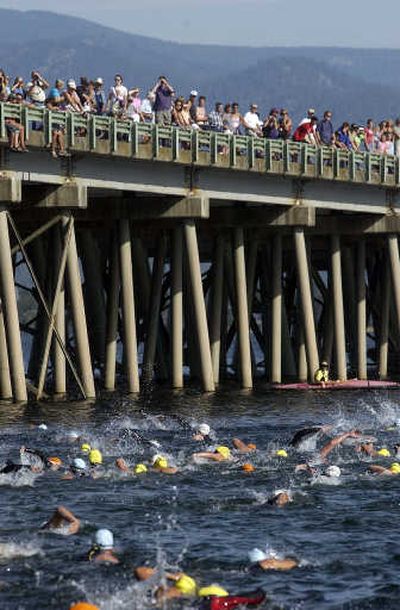
There are other Northwest open-water swims, but Sandpoint’s is a particularly welcoming one for all kinds of swimmers. Participants have ranged in age from 7 to 84.
The rules provide for swimmers’ safety but don’t address competitive advantage, giving swimmers a lot of options. Some wear wetsuits, others life jackets; some propel themselves with the support of kickboards or inflatable toys.
More than 100 kayakers paddle among them for support and safety, while other volunteers take care of logistical issues ashore. Law enforcement agencies patrol both sides of the group to prevent unwary boaters from plowing into the stroking and kicking hordes.
And because the event is carried out next to the bridge, hundreds more fans and family members are able to walk alongside and cheer on their favorite swimmers.