
Sandy River soon to run free
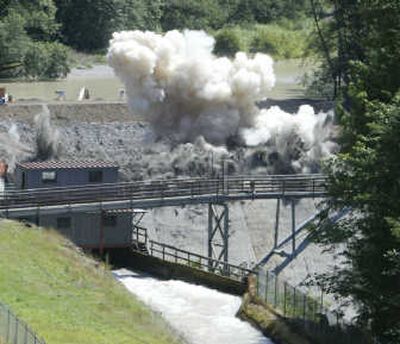
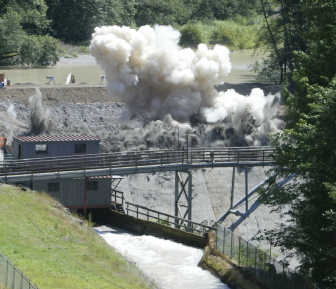
SANDY, Ore. – The CEO of Oregon’s largest utility detonated explosives on the Marmot Dam on July 24, the beginning of the end of a 47-foot concrete hydroelectric dam that has blocked the Sandy River for nearly a century and hindered steelhead and salmon from reaching their spawning grounds.
When the Marmot is totally dismantled later this summer, the Sandy will again be a free-flowing river – from its origin high on Mount Hood to its mouth on the Columbia River.
“The bottom line is that it’s good for fish and saves our customers money,” Peggy Fowler, CEO and president of Portland General Electric, said at a ceremony just before pushing down on a plunger-style detonator straight out of the Old West.
The explosion cracked the dam enough to allow crews to begin hammering and drilling while a temporary earthen dam diverts water around the site.
Fowler told environmentalists, state and federal government officials, and lawmakers at the site that their eight-year effort was a model of cooperation to preserve threatened fish runs and expand wildlife habitat.
The utility also had determined that they were better off paying the $17 million demolition costs than maintenance fees made higher by newer environmental regulations.
The Sandy is a legendary steelhead river, and PGE’s decision to assist those fish and others on the river was welcomed by environmental groups.
“The undammed Sandy River, flowing freely from Mount Hood to the Columbia, will be good for local businesses, clean water, and fish and wildlife,” said Amy Kober of American Rivers. “The Sandy will show us that when a river is healthy, we all thrive.”
Marmot Dam was part of the Bull Run Hydroelectric Project that went on line in 1913 to provide power to a younger Portland decades before the more massive dams were built along the Columbia River. The Bull Run project provides enough electricity to power more than 10,000 homes.
PGE is donating about 1,500 acres on the Bull Run Project for fish and wildlife habitat, and for public recreation. The area will be the centerpiece of a planned 9,000-acre natural resource and recreation area, officials say.
Decommissioning hydroelectric projects has been rare. The Federal Energy Regulatory Commission has authorized fewer than a couple of dozen out of more than 1,600 project proposals nationwide.
Most dams set for removal are small and date from the early 1900s.
PacifiCorp, another private utility based in Portland, has plans to remove dams from the Hood River, and from the White Salmon River in Washington and the American Fork River in Utah. Pacific Gas and Electric, California’s biggest utility, plans to remove a dam from a tributary of the Feather River in Northern California.
Other dams set for decommissioning include the Savage Rapids Dam along Oregon’s Rogue River and two dams along the Elwha River in Washington – including what will be the nation’s tallest dam to be decommissioned at 210 feet. Before the dams, the Elwha attracted a spawning run of huge chinook salmon ranging to more than 90 pounds.