
Training Wheels: Young drivers benefit from a little on-hands experience
Early on a warm July morning a large group of teens slumped at desks at Mead High School, watching a video. These weren’t summer school students, and they weren’t thinking about the WASL. The drowsy teens had car keys and road trips on their minds. This driver’s training class will take them one step closer that goal.
Becci Humphrey, who owns and operates B&B Driving School with her husband, Eldyn, said the summer months are their busiest time.
Fifteen-year-old Joanna Luse said she was there because “I have after-school sports all year, every day during school.” About a quarter of the class agreed that getting their training out of the way in summer freed them to participate in sports. Others said they prefer to concentrate on their classroom studies during the school year.
The lure of independence drew the kids to get out of bed and show up for an 8 a.m. class. “I’m excited to go on road trips with my friends,” said Jill Pecka, 15. Vicky Radke had a more prosaic goal in mind; “I’m looking forward to not taking the bus to school this year.”
Elysia Villanueva agreed. “It’ll be great not having my parents drive me around all the time,” she said.
Some teens already own a car. Sixteen-year-old Andrew Hentges has a 2001 Chevy Lumina waiting for him. “I bought it from my parents,” he said.
Before Hentges can get his license and hit the road, he must pass a driver’s education course which includes 30 hours of classroom instruction, four hours of behind- the-wheel training, one hour of behind-the-wheel observation, and 50 hours of out-of-class practice time.
But those requirements are about to change. “In September the required behind-the-wheel instruction will increase from four hours to six,” said Humphrey.
According to the Washington State Department of Transportation, “For the youngest drivers, inexperience or immaturity make driving very hazardous. In the 15- to 20-year-old age bracket, motor vehicle accidents are the leading cause of death in Washington State.”
Risky business
The DOT reports that newly licensed drivers with less than one year of driving experience have the highest crash rate of any driver group.
Washington State Patrol trooper Mark Baker concurred. “One hundred and thirty-two teens died in traffic-related collisions last year, which is way too many. One is too many.”
Motor vehicle accidents are the leading cause of death for teens nationwide, which is sobering news for parents with teens itching to get behind the wheel.
Deb Harper, a Group Health pediatrician, predicts one out of three kids will be in a car accident within the first year of driving. This statistic proved true in her own family. Harper is the mother of three sons, 16, 18 and 19. One of them totaled her new car when he was 17. Fortunately, he walked away unscathed. After the accident, he grew well acquainted with the Spokane Transit Authority system, Harper said.
She said of teen drivers, “Their reflexes are great, but their experience is poor. They lack impulse control and live very much in the now.”
According to data from the Center for Disease Control and Prevention, teens are more likely than older drivers to underestimate dangerous situations. They also tend to practice some unsafe habits.
WSP Trooper Baker explained, “The most common infractions we cite teens for are speed and following too closely.”
In 2001, Washington’s intermediate driver’s license law, which restricts passengers and the hours teens can drive, took effect. Since then, the state has experienced a 41 percent drop in the number of fatal and disabling injuries involving 16- and 17-year-old drivers.
Becci Humphrey said several pieces of legislation are in the works aimed at keeping teens safe, including an initiative to raise the legal driving age to 17.
Taking a spin
B&B Driving School recently purchased a car called the “Skid Monster.”
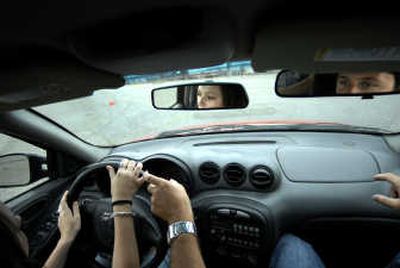
The bright red and yellow vehicle is designed to go into skids, so students can practice how to plan and maneuver in the event it happens to them in real life. The car has two tiny rear wheels that resemble bicycle training wheels.
A group of students recently gathered in a parking lot at the Spokane Fair and Expo Center to give it a spin – literally.
Lisa Lloyd said she and her two sons recently moved here from southern California. “We have no experience with winter driving,” she said. “I still white-knuckle it.” She watched as her sons, Neal and Trevon, and their friend, Brynn, accompanied by their instructor, attempted to steer the skidding car around orange traffic cones.
“It was intense,” said 15-year-old Trevon as he emerged from the car.
Instructor Eldyn Humphrey said the top speed in the car is only 14 mph, but it simulates up to 60 mph while in a skid. Indeed, to observers the car seemed to sail as it slid sideways down the course. “They all have some anxiety,” he said of the students. “We push them to failure so they’ll know how to react.”
As Colleen Shafer watched instructor Ryan Humphrey take her daughter Ali through the course, she said, “Anything you can do to keep your kid safe on the road is worth it.”
Fellow parent Susie Amini agreed. Her son Jacob emerged from the Skid Monster with a huge grin. “That was a blast,” he said. Both teens talked about the importance of keeping their eyes on target and their speed under control.
At 911 Driving School in Spokane, owner and instructor AJ Seitz said their main market is teen drivers. As a former officer in the Puyallup police department, he witnessed the aftermath of teen traffic fatalities. He said teens often have unrealistic expectations of what their vehicle can handle and of their own skills. At his school, his law-enforcement experience adds a unique dimension to the instruction. “We incorporate a lot of the techniques we learned in driving emergency vehicles,” he said. “Defensive driving is important.”
Harper and Baker both believe kids need more than driver’s education to keep them safe. They need parental involvement as well.
“I encourage parents to be parents,” said Harper. “Parents need to educate themselves about the safest make of cars. I won’t buy any more cars without side airbags.”
“Let teenagers know they’re not invincible,” said Baker. “Driving is probably the single most dangerous thing we do on a daily basis.”