
Throwback Theater: Wallace’s Sixth Street Melodrama follows historic formula
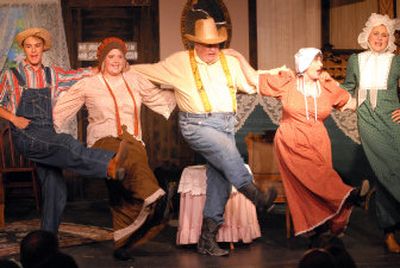
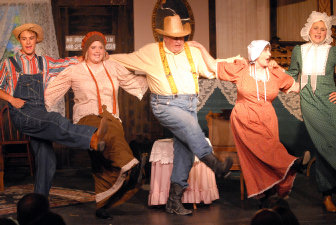
Step into the Sixth Street Melodrama in Wallace and step back into theatrical history about 120 years.
No, the Sixth Street Melodrama isn’t that old. This popular summer tourist attraction in North Idaho’s Silver Valley is a mere youngster at age 24.
But the artistic genre called “the melodrama” is at least 120 years old and maybe closer to 220.
Yet somehow, modern audiences instinctively know how to play their parts.
During one July performance of “Nightmare at Dream Gulch, Or … Wake Me When It’s Over,” the near-capacity audience enthusiastically hissed the nefarious Molly B’Holden (Vickie Weil) as she hatched a plot to rob the virtuous Rev. Floyd Davis (Paul Roberts) of his mining claim.
And when the beautiful and willowy Katy Donnelly (Molly Roberts) launched into an Irish song, the audience let out a heartfelt, simultaneous sigh.
The theater’s August production, “Tied to the Tracks,” is an old-fashioned melodrama purchased from a catalog. Yet occasionally, the Sixth Street goes local, as in “Nightmare at Dream Gulch,” written by Carol Woolum Roberts, one of the show’s cast members.
She ran across an old legend about a prospector in the Silver Valley and thought it had the makings of melodrama. So she sat down and wrote it out.
“Maybe it’s a true story and maybe not, but it’s a great little plot and plus people can learn some history,” said Roberts, an office manager at a pet veterinary clinic and writer of historical fiction.
Both that show and this month’s offering conform perfectly to the centuries-old melodrama formula.
Think “The Scarlet Pimpernel.” Think “The Perils of Pauline.” Think “Dudley Do-Right.”
“There’s always a hero or heroine, there’s always a villain or villainess, and most often there’s some sweet young thing,” said Vern Hanson, the president of the theater’s board and a longtime melodrama actor.
“It’s an audience participation show and we encourage people to boo the villain and cheer the hero. The actors will usually respond.”
For instance, when the crowd booed Molly B’Holden, the actress playing her, Weil, wheeled around, brandished her gun at the crowd and sneered. The audience, naturally, booed louder.
“It’s fun because you get to almost over-act,” said Carol Woolum Roberts. “You want to get that reaction from the audience.”
Subtlety has no place in melodrama.
“I spent years trying to act natural on stage,” said Hanson. “And now I have to act melodramatically, with the hand to the forehead.”
Part of the pleasure consists in the sheer corniness of the whole thing.
“You are a lot more relaxed, because if you mess up, you can go with it,” said Roberts. “You can just talk to the audience. They get a big kick out of it.”
Melodrama is also decidedly family-friendly. One character in “Nightmare at Dream Gulch” was called “an ass-ayer, an ass-essor, and a jack-ass.” That’s about as raunchy as it gets.
Melodramas like the one at Wallace are generally staged in tourist towns, in which the goal is to take people on a nostalgic trip to the 1880s or 1890s. Yet the genre of melodrama goes back much earlier.
According to “The Oxford Companion to the Theatre,” the original German and French melodramas in the 18th century were simple dramas with incidental music (“melos” being the Greek root for “song”).
In the 19th century, the music was gradually phased out and the stories evolved into tales of lurid crime, domestic conflict, vice and virtue triumphant.
These kinds of uncomplicated, yet emotional dramas were imported to English and American stages in the early 1800s. The virtuous characters were always poor and the villainous characters were always rich. The mustache-twirling landlord was constantly threatening the fair-haired young damsel.
The original audiences took these stories seriously. Only later, when theatergoers became more sophisticated, were the plays revived for their campy, boo-hiss appeal.
In 1983, a group of Silver Valley people, including Don and Jan Springer and Sherrill and Pat Grounds, decided that a melodrama would be a fun and historic way to celebrate Idaho’s centennial.
They staged that first melodrama for a crowd sitting on folding chairs in an old grocery store. It was an immediate hit.
In 1984, Don Springer bought the historic Kelly building and converted it into a cozy, old-timey theater. The Sixth Street Melodrama has been going strong ever since.
“We’re full most of the time,” Hanson said. “People need to make advance reservations or they may not get in. We sell over 6,000 seats a year.”
The theater produces conventional plays in the fall and spring for a mostly local crowd, but the summer melodrama audience is probably 60 percent tourist.
“I think this is huge for Wallace,” said Hanson. “Many of these people have dinner here and spend the night.”
The shows are produced almost entirely with Silver Valley talent. Some are high school and college students on summer vacation and some are enthusiastic adults. Paul Roberts will be the drama teacher at Kellogg High School this year.
The actors are paid a small stipend. Some are stage veterans and some are total amateurs, but melodrama is a forgiving art form. The mistakes are often the funniest parts – many times, a miscue is incorporated into the show because it gets such a good laugh.
“In our last performance, the curtain didn’t come down all the way, and I just started ad-libbing and laughing,” said Carol Roberts.
In keeping with the musical origins of melodrama, the second half of every performance is the traditional “olio”: a musical variety show called the Kelly’s Alley Revue. The revue leans toward nostalgic songs and corny jokes about farmers and their cows.
The plays themselves aren’t much more sophisticated. Yet when you take in the Sixth Street Melodrama, you will actually be participating in a centuries-old theatrical tradition – and having a barrel of fun at the same time.