
Utah mine rescue effort suspended
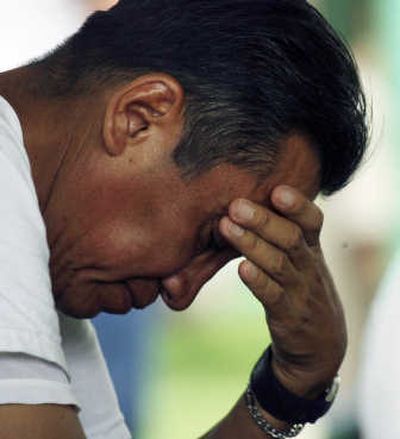
HUNTINGTON, Utah – After 10 days of setbacks, nerve-jangling “bumps” and a second mine collapse that killed three workers trying to rescue their comrades, authorities Friday conceded defeat to a mountain that appeared to be slowly crumbling.
“Is there any possible way we can continue this underground operation and provide safety for the rescue workers? At this point we don’t have an answer,” federal Mine Safety and Health Administration chief Richard Stickler said as he announced that officials had suspended the rescue operation indefinitely.
The collapse Thursday night killed three rescue workers and injured six others who were trying to tunnel through rubble to reach six men trapped since Aug. 6 after a massive cave-in.
Crews on Friday were still drilling a fourth hole into the mountain to look for any sign of the missing men.
“Without question, we have suffered a setback, and we have incurred an incredible loss. But this team remains focused on the task at hand” – the rescue of the miners, said Rob Moore, vice president of Murray Energy Corp., co-owner of the Crandall Canyon mine.
Said Utah Gov. Jon Huntsman, who ordered flags lowered to half staff: “We went from a tragedy to a catastrophe.”
Huntsman continued to call the effort a “rescue operation,” but he said the digging would not resume until workers’ safety could be guaranteed.
“Let us ensure that we have no more injuries. We have suffered enough as a state,” he said.
President Bush called Huntsman on Friday afternoon to express his condolences for those who died or were injured in the mine rescue.
Mexico’s consul in Salt Lake City, Salvador Jimenez, said he spoke with Huntsman and urged him to continue the rescue effort. While experts need to study the best way to do it safely, “this effort should not be interrupted,” Jimenez said. Three of the six men still trapped are Mexican nationals.
The cave-in at 6:39 p.m. was believed to be caused by a “mountain bump,” in which shifting layers of earth forced chunks of rock from the walls. The force from the bump registered a magnitude 1.6 at the University of Utah seismograph stations in Salt Lake City.
“These events seem to be related to ongoing settling of the rock mass following the main event,” university spokesman Lee Siegel said. “I don’t think I’m going too far to say that this mountain is collapsing in slow motion.”
Stickler said the bump unleashed a massive blast of coal and support material that buried the miners working to clear rubble from the underground tunnel.
The blast created a destruction zone about 30 feet long along a wall of the chamber and knocked out steel posts, chain link fencing and the cables that tied everything together.
The rescuers had been working beneath 2,000 feet of sandstone. Stickler said the weight of the mountain created tremendous pressure on the cavern, blowing out reinforced walls with a force that could break a 40-ton mining machine in half.
“When that energy gets released, it’s like an explosion,” he said.
Rescuers frantically dug out the injured men, buried under 5 feet of coal, by hand and rushed them from the mine on the beds of pickups. One died at the scene, said Kevin Stricklin, MSHA’s administrator for coal mine safety.
Two of the dead were identified as MSHA inspector Gary Jensen, 53, of Redmond, and miner Dale Black, 48, of Huntington.
Jensen had worked at MSHA since 2001 and was recently assigned to special investigations, agency spokeswoman Amy Louviere said.
Black grew up two doors from Huntington Mayor Hilary Gordon, who visited his mother Friday and recalled that he was “just full of life.”
The president of the United Mine Workers of America, Cecil E. Roberts, blamed the mine’s owners and federal officials for the latest tragedy. Owners of the nonunion mine had rejected UMW offers to help in the rescue effort, saying they had all the help they needed.