
Rescuers fight to reel in a problem
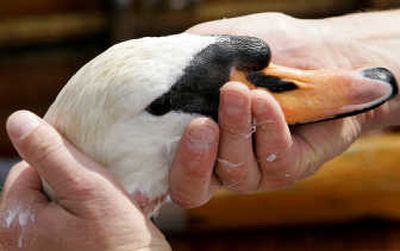
Every year, thousands of wild birds and reptiles fall prey to fishing line, hooks and lead sinkers because uneducated or careless anglers leave them behind.
Pelicans and other seabirds bear the brunt of such injuries along the Florida and California coastlines, where sport fishing is year-round, but fishing-related injuries increase dramatically inland during the summer and fall when the nation’s 44 million recreational anglers are out in full force, littering the nation’s waterways with the discarded remnants of their trade.
Already more tragedies are unfolding.
“A bald eagle is being treated at The Virginia Wildlife Refuge in Waynesboro, North America’s largest wildlife hospital, for a fishing hook imbedded in its intestine.
“A black-crowned heron received a wing feather transplant earlier this year after it was found dangling from a telephone wire near Sacramento, fishing line attached to its wing caught in the wire.
“A red-throated loon was brought to (South) Carolina Wildlife Care recently with fishing line wrapped so tightly around its jaw, it could no longer forage for food.
“A ring-billed gull was rescued by the Wisconsin Humane Society in Milwaukee recently after it was found dangling from a tree, its primary feathers wrapped in fishing line.
“The bird hung there overnight because no one knew who to call,” said wildlife manager Scott Diehl, who has since treated and released the gull.
Monofilament — a nylon line used for fishing — lurks, often unseen, along the edges of lakes, ponds, streams and rivers. Geese and ducks find it streaming from their wings. Pelicans get trapped in the line or swallow fish with hooks inside. Even songbirds don’t escape. A mother sparrow will get caught in fishing line, and inadvertently carry it back to the nest where the young become trapped.
“People don’t realize the long-term implications,” says Marie Strasburger, a biologist with the U.S. Fish and Wildlife Service in Washington, D.C. Just picking up fishing line, she adds, would mean huge benefits for the environment — not just in sparing birds and reptiles unnecessary suffering — but in cleaning up our waters and shorelines.
Neither the U.S. Fish and Wildlife Service nor the American Sport Fishing Association keeps statistics but wildlife experts and rehabilitators — those who must deal with the grim, often tragic consequences — estimate such entanglements have led to the deaths of thousands of birds, as well as the amputation of limbs of many others. Fishing-related injuries also spiral during the summer vacation months when the primary victims move beyond pelicans to include the “inland” birds — eagles, hawks, Canada geese, trumpeter swans, owls and songbirds.
The Alabama Wildlife Rehabilitation Center in Birmingham, the state’s largest full-sized wildlife facility, rescued 70 victims of fishing gear in the last four years, among them a red-tail hawk whose nerves were so shattered by fishing line it can no longer survive on its own.
“Canada geese are our big problem,” says director Anne Miller.
In addition to the eagles, the Virginia facility expects to see at least 30 fishing-related injuries this summer. “People are just slobs. There’s no other way to put it,” says Ed Clark, an angler himself. “There’s a basic indifference that’s almost at odds with the sport.”
Rescue missions themselves can be daunting. Trying to capture a Canada goose — or any waterfowl with wings — is like trying to catch a dinosaur in heat. As soon as you get close, they fly off.
Wildlife facilitators say that unknown numbers of geese and other birds, unable to be rescued, experience slow, agonizing deaths.
“It’s a horrible way to die,” says Weitzel. “Starvation sets in, or creatures amputate their own legs to get free or inadvertently hang themselves when the line becomes entangled in brush.”
Rescuers say the problem lies in educating the public, particularly anglers who don’t recognize the dangers of tossing fishing debris into the waters or leaving it on land.
“We think anglers would dispose of fishing line responsibly if they knew the problems they were causing,” says Wisconsin wildlife manager Diehl. Rob Southwick of the American Sport Fishing Association, said it’s certainly not considered “cool” to leave fishing line around.
“There’s almost a social stigma against it,” he says, although he adds that many anglers apparently “aren’t getting it.”