
Hair’s the fascinating artwork
HANOVER, N.H. – The massive banner in Dartmouth College’s Baker-Berry Library runs the length of the vast foyer, bright green lettering stretching from end to end.
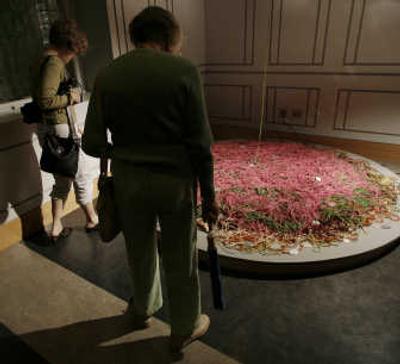
But the gut reactions that artist Wenda Gu’s latest installation provokes aren’t because of its size, but its contents: 420 pounds of human hair.
A viewer’s first impulses are to lean forward and scrutinize the swirling, flattened locks; stealthily sniff (it doesn’t smell); and fight the urge to touch it – and perhaps quickly recoil.
Sophomore Julian Ng has spent a lot of time with “united nations: the green house,” which hangs just feet from the information desk where he works.
Part of his job involves handing out brochures on the artwork and explaining that the unrecognizable green lettering spells the words “educations” and “advertises” superimposed on each other.
Ng says viewer reactions fall into two camps: the freaked out and the fascinated.
“A lot of people don’t understand that it’s hair,” he says. When they do, “they get really freaked out.”
Then again, “I’ve seen a lot of people try to look closely to see different hairs,” he says.
Maybe they’re looking for a piece of themselves.
Hair for the 80-foot-by-13-foot banner was collected over several months last year from 42,000 haircuts of Dartmouth students, faculty, staff and local residents in Hanover. It was shipped to China, where workers in Gu’s Shanghai studio dyed and shaped the locks into paper-thin panels held together by a film of Elmer’s glue and tied together with twine.
It and a second work, “united nations: united colors,” displayed in another part of the library, are the latest installations in Gu’s worldwide “united nations” project, begun in 1993 and all made from human hair.
The banner’s “green house” title and green lettering symbolize not just Dartmouth, whose nickname is “the Big Green,” but money.
Gu’s unconventional medium, and his message – that education and capitalism are inseparable – have drawn mixed responses since the unveiling in June.
There’s confusion.
“I know it probably has some other meaning,” says 20-year-old history and Spanish major Laura Sayler. “When I think of it, I don’t think of that other meaning. I just think of, like, hair.”
There’s admiration.
“I’m amazed by it,” says Sandra Michael, a visitor from New York who went to the exhibit looking for the coarse locks of African-American hair but couldn’t pick them out.
“It shows me that there is no difference because I can’t see it. … Someone who can create something like this, to think of something like this and then to create it, it’s phenomenal.”
And there’s contempt.
“Absolutely lacking in aesthetics. What … pretentious junk. The artist and the commissioner ought to be ashamed. So many flaws,” one viewer wrote in a comment book.
Zak Moore, a columnist for Dartmouth’s student newspaper, worries that the “somewhat gross and unattractive” show might turn away prospective students.
“When I find a piece of disconnected hair on or near my food or person, I am disgusted. … Now we are surrounding ourselves with the same gross substance? And while we are trying to study no less!” he wrote.
Viewers who move past any initial disgust will be rewarded, says Brian Kennedy, director of Dartmouth’s Hood Museum, which commissioned Gu to create art in unexpected places.
“It’s the transformative possibility of the hair that (Gu’s) exploring,” Kennedy says. “It’s transformed into a translucent screen, which defies its material.”
Gu’s second installation is a braid of roughly 7 1/2 miles of hair purchased from wig factories in China and India. Rising from a spaghettilike mass and hanging in long loops on both sides of the library’s central corridor, it elicits a generally positive reaction.
Stainless steel medallions attached to sections of braid dyed in electric colors bear the names of 207 countries. Written backward, the familiar becomes unfamiliar, leaving viewers to puzzle over the letters (Finland becomes “dnalnif,” Lebanon “nonabel”) and smile at the decoding.
Gu was born and raised in Mao-era Communist China and came of age during the Cultural Revolution. He moved to the United States in 1987 and these days divides his time between Brooklyn and Shanghai.
He says he chose human hair for “united nations” to break from conventional materials and to bring people closer to his work; over the years, 4 million people have donated hair to installations in the United States, Canada, Australia, Hong Kong, Taiwan, Israel and several European countries.
“I had kind of an ambition to try to bring all people together for my work, so it’s kind of an age-of-utopia idea (to) try to unify … mankind,” says Gu.