
Clinton says health care coverage must change
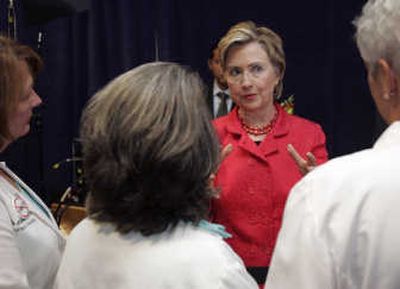
LEBANON, N.H. – Almost 15 years ago, first lady Hillary Clinton came to the Dartmouth-Hitchcock Medical Center to kick off the push for universal health care coverage, attempting to turn the existing health system on its head.
“The status quo is not acceptable,” she declared. “Standing still will not protect what we have.”
Her well-received visit was followed, however, by turmoil and eventual implosion back in Washington. Clinton’s penchant for secret meetings to develop the plan had angered members of Congress who felt shut out. The insurance industry derided her proposals with its “Harry and Louise” commercials, fomenting anxiety among the public. And what began with much fanfare died an ignominious death.
Now years later, the former first lady is running for president and it was deja vu all over again as she returned to this state’s premier teaching hospital Thursday in her continued quest for a system of universal health care.
“Everyone tells me the same thing,” she told an audience of doctors, nurses and other hospital workers. “Our health care system isn’t working and what can we do about it. The cost is too high and the coverage too thin; the care is not what it should be.”
But the campaign manager for a Democratic rival, former Sen. John Edwards, said Clinton should place the blame for that on her own shoulders.
“The Clintons had a choice to push NAFTA or universal health care and they chose NAFTA,” said David Bonior, a former Michigan congressman. “NAFTA has cost us millions of jobs and, without universal health care, over 47 million Americans are left uninsured.
“Most troubling, Sen. Clinton has had years to come up with a plan and we’re all still waiting – the question is, what is Sen. Clinton waiting for?” Bonior asked.
According to the most recent census figures, there are 45 million uninsured Americans.
Even Clinton acknowledged that her first run at the health care system did not go well.
“I have worked on health care issues for more years than I care to recount,” she said, repeating a self-deprecating line she has delivered in the past. “Despite the scars I carry from that, I’ve learned some very valuable lessons.”
Clinton said she understands that there needs to be a consensus among health care providers, employers and citizens “to overcome forces that oppose change for ideological and corporate reasons.”
Edwards also spoke Thursday in nearby Hanover, where he blamed lobbyists for insurance companies, drug companies and HMOs for blocking health care reform.
“If we end the game in Washington, we can finally have a health care system that treats the health of all of our people with equal worth,” said Edwards, who has repeatedly criticized Clinton for taking campaign contributions from lobbyists.
Clinton’s speech was the second of three speeches she plans to give about her ideas for overhauling the health care system. At George Washington University in May, she focused on reining in health costs. On Thursday, in a dry, 40-minute talk, she described ways to ensure high-quality care. And she said that in September she would unveil her ideas for achieving universal coverage.
“I hope we’re getting to a point where the quality of our health care is not a partisan issue,” she said. “If you’re a Democrat or a Republican, liberal or conservative, none of us wants to rush our child to the emergency room only to receive the wrong treatment.”
Clinton also decried a lack of money for the National Institutes of Health and the National Science Foundation that she said is choking off funds to young researchers.
“There’s been an assault on science that has been carried out by the administration to the great detriment of our country,” said Clinton.
And she called for lifting the restrictions on federal funding for embryonic stem cell research, an issue that has unsuccessfully pitted Congress against the White House.