
Rite of tradition
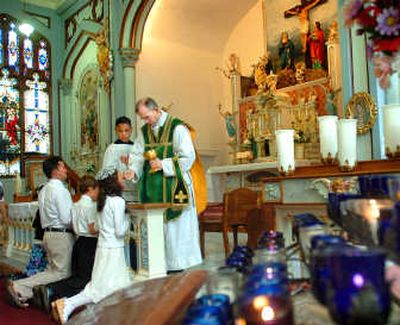
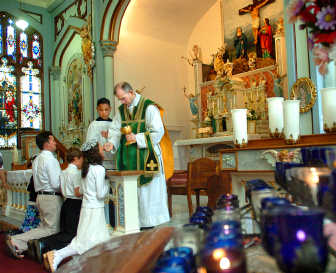
In an elaborate chapel – illuminated by stained-glass windows and adorned with statues of Jesus, Mary, angels and saints – a congregation worships in silence.
Heads bowed, hands clasped together in prayer, the people in the pews don’t say a word during Mass at Mount St. Michael. They simply fall to their knees in reverence, meditating on an ancient liturgy offered by the priest before the candlelit altar.
“In nomine Patris, et Filii, et Spiritus Sancti,” the Rev. Casimir Puskorius says quietly in Latin while organ music fills the sanctuary.
“Amen,” reply the two altar boys dressed in black, floor-length cassocks with white surplices.
Their voices are almost inaudible, but that’s of no consequence to those in the pews. Some know the traditional Latin Mass by heart; others follow along using missals that contain words in Latin on the left-hand pages with the English translation on the right.
For traditional Catholics who celebrate the centuries-old Tridentine Rite, the Mass is a sacrifice they offer to God – a time to repent for their sins as they remember Jesus’ death and an opportunity to bow down in worship and adoration.
“Mass is about being there with Jesus through his passion and death,” said Doranne McMahon, who moved to Spokane from New York 16 years ago to become a member of Mount St. Michael.
“Mass is about being reverent, pious and fervent – everything I believe our Lord deserves. … It is my source of strength and solace.”
Although deemed “schismatic,” or not in good standing with the hierarchy of the official Roman Catholic Church, “traditional” Catholic churches such as Mount St. Michael in north Spokane and Immaculate Conception Church in Post Falls are experiencing steady and sometimes significant growth.
In fact, the Inland Northwest – a region where the Tridentine Rite is offered at roughly 10 churches, chapels and sites, according to the National Registry of Traditional Latin Masses – has become one of the country’s hotbeds for traditional Catholicism.
Immaculate Conception, where Masses are celebrated by priests from the Society of St. Pius X, was a congregation of only 500 members less than a decade ago. Since then, membership has grown to more than 2,000 people, according to the church office.
Our Lady of Guadalupe in north Spokane started out with only 50 or 60 people when Latin Mass was first offered a dozen years ago, said the Rev. Kevin Vaillancourt, an independent priest and the church’s pastor. These days, as many as 210 people, or roughly 65 families, claim the church as their own.
Membership at Mount St. Michael has remained steady in recent years at about 700 people, an increase of at least 200 in the last decade.
Like other traditional Catholic churches in the area, the congregation of Mount St. Michael includes many young people and families with little children. While some of these young adults were raised in the traditional Catholic Church and even graduated from St. Michael’s Academy on the Mount, others are people who seek a more orthodox faith experience.
“There’s something seriously lacking in society,” says Paul Scherling, 34. “People are yearning for something stable, something constant, something true. They find that right here in this church.”
Traditional Catholics believe in the papacy but do not recognize Benedict XVI as the true pope. They also reject the changes established more than 40 years ago by the Second Vatican Council, which modernized the Catholic Church.
The issue is, of course, bigger than the traditional Latin Mass. But the rite is perhaps one of the most tangible differences between the ultra-traditionalists and those who celebrate Mass in the vernacular and belong to the official Catholic Church.
“Church is going to God’s house and worshipping him,” says Puskorius, pastor of Mount St. Michael’s and one of several priests in the area who belong to the Congregation of Mary Immaculate Queen.
“There’s not a lot of active participation, but people appreciate the beauty of the liturgy. The new Mass can’t draw people in this way – it’s more of a social event than an act of worship.”
Mass at Mount St. Michael and the other traditional churches is a time of reverence and solemnity. People immediately genuflect as they enter the chapel in silence and do so again as they find a place in the pews.
Everyone dresses conservatively – no shorts, miniskirts or tank tops at Sunday Mass. Women are encouraged to wear loose clothing that covers their knees and elbows. They also have to wear a veil, hat or lace mantilla on their heads.
A brochure about Mount St. Michael also emphasizes modesty to visitors:
“The Catholic Church observes the admonition of St. Paul in 1 Corinthians: ‘Doth it become a woman to pray with head uncovered?’ … Wearing modest and appropriate attire at Holy Mass is a sign of respect for Our Lord in the Blessed Sacrament and of fraternal charity for our neighbor.”
During Mass, parishioners hear only traditional organ music or the choir singing mostly Latin hymns. There are no responsorial psalms or shaking hands during a sign of peace.
The priest, who performs all the actions and recites all the prayers, faces the altar instead of the congregation. For communion, people kneel down at the altar rail. The host is received on the tongue and is never touched except by the anointed hands of a priest.
While the Mass in the vernacular or Novus Ordo stresses the resurrection of Christ, the traditional Latin Mass focuses on his suffering and death, says the Rev. Michael Irwin.
Irwin, a priest in the Catholic Diocese of Boise, has received permission from Bishop Michael Driscoll to celebrate the Tridentine Rite at the Golden Spike Clubhouse in Rathdrum.
A priest for the last 43 years, Irwin, 70, said he has always found the traditional Latin Mass more comfortable and rewarding. He no longer celebrates the Novus Ordo, he says.
The traditional Latin Mass is often a humbling experience, says Tom Gallegos, a longtime parishioner at Mount St. Michael’s.
“You are on sacred ground,” he says. “There is a sense of mystery there, a recognition that God is almighty – that he is our savior and redeemer, instead of Jesus as my buddy and friend. …
“It’s about God, not the people.”
Parishioners at the traditional churches in the region are so fervent in their beliefs that many actually quit jobs in other cities and uprooted their families so that they could attend Latin Mass on Sundays, and sometimes every day.
McMahon, 51, was working as a New York City police officer when she first visited Mount St. Michael in April 1991. Her husband and other family members had been there before for retreats and conferences, but McMahon had only heard about the ornate chapel, the grotto and the historic building that the Jesuits erected in 1915.
She “fell in love” with the place to the point she felt compelled to uproot her family to be close by. A nun told her to pray to St. Michael, the patron saint of police officers.
McMahon and her husband, also a police officer, ended up quitting their jobs and moving their four children to Spokane less than six months later.
Born and raised Catholic, McMahon has attended only one Novus Ordo Mass in her entire life.
In 1967, when she was 12, her family went to church at Our Lady Queen of Martyrs on Long Island, she recalls. But right the middle of the service, her dad suddenly stood up with an expression of disgust on his face. He looked at his wife and seven children, and pointed toward the door.
“I don’t know what church this is, but it’s not Catholic,” he later told his kids outside.
Many at Mount St. Michael, Our Lady of Guadalupe, Immaculate Conception and the other traditional churches have similar stories of being offended by the modernization of Vatican II.
Although most mainline Catholics view them as extremists or part of a schismatic group, these traditionalists often say they’re the ones who remained true to the church while everyone else left.
They’re not stubborn separatists, many say; they simply want to hold fast to the traditional teachings of the church as they have been handed down through the centuries.
And part of maintaining tradition is keeping Mass in Latin, a dead language that can never be altered.
“The traditional Latin Mass is an expression of the unchanging truths of the Catholic Church,” Gallegos said.
Reach reporter Virginia de Leon at (509) 459-5312 or virginiad@spokesman.com.