
Fire halted at edge of ruins
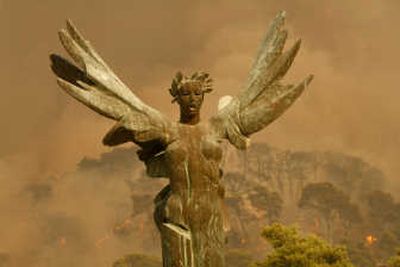
ANCIENT OLYMPIA, Greece – Firefighters backed by aircraft dropped water and foam Sunday on the birthplace of the ancient Olympics to stop wildfires from burning the 2,800-year-old ruins, one of the most revered sites of antiquity.
But the fires burning for three straight days obliterated vast swathes of the country and the death toll rose by 11 on Sunday to 60. New fires broke out faster than others could be brought under control. Desperate residents appealed through television stations for help from a firefighting service already stretched to the limit and many blamed authorities for leaving them defenseless.
“Fires are burning in more than half the country,” said fire department spokesman Nikos Diamandis. “This is definitely an unprecedented disaster for Greece.”
Early today, the fire department said 42 major fires were still out of control.
Government and firefighting officials have suggested arson caused many of the blazes, and several people had been arrested. The government offered a reward of up to $1.36 million for anyone providing information that would lead to the arrest of an arsonist.
The front of one fire Sunday reached Ancient Olympia in southern Greece, burning trees and shrubs just a few yards from the museum at the site. Firefighters said the flames, fanned by high winds and swirling air, leaped hundreds of feet in the air at times.
The nearby grounds of the International Olympic Academy were completely burned, as was the grove where the heart of Pierre de Coubertin, the founder of the modern Olympic Games, is buried.
Although the pristine forest around Ancient Olympia was burned, none of the ruins was damaged.
Ruined temples of Zeus, king of the ancient Greek gods, and his wife, Hera, stand on what was a lush riverside site – a flat stretch of land surrounded by pine-clad hills – near the stadium that hosted the ancient Olympic games for more than 1,000 years after they started in 776 B.C.
Helicopters and aircraft covered the ruins with water and foam. The flames reached the edge of the ancient stadium, searing the grass and incinerating the trees on the hill above. Firefighters remained in the area after dark to ensure the fire did not re-ignite.
The fire also blazed into the nearby village of Varvasaina, destroying several houses. As residents rushed to battle the flames, others, stunned, walked the streets holding their heads in their hands.
The worst of the fires have been concentrated in the mountains of the Peloponnese in the south and on the island of Evia north of Athens. Strong winds blew smoke and ash over the capital, blackening the evening sky and turning the rising moon red.
In the ravaged mountain villages in the Peloponnese, rescue crews found a grim scene that spoke of last-minute desperation as the fires closed in. Dozens of charred bodies have been found across fields, homes, along roads and in cars.
The remains of a mother hugging her four children were found near the town of Zaharo in the western Peloponnese.
Elsewhere, flames were about less than two miles from the Temple of Apollo Epikourios, a 2,500-year-old monument near the town of Andritsaina in the southwestern Peloponnese, said the town’s mayor, Tryphon Athanassopoulos.
“We are trying to save the Temple of Apollo, as well as Andritsaina itself,” he told Greek television.
Across the country, churchgoers prayed for the blazes to abate.