
Assessor tries out telecommuting

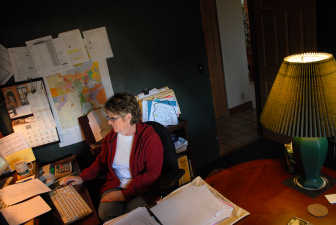
People with computers generally don’t need to leave home these days to conduct business with the Spokane County Assessor’s Office. Now Assessor Ralph Baker wants to let some employees stay home, too.
The technology-embracing assessor thinks it’s good policy, when possible, to accommodate employees who want to work outside the office. And, “if we can reduce the cost of a commute, then we all win.”
Better still if Baker can retain an experienced employee like levy specialist Connie Kline, who didn’t want to continue commuting from her Ritzville-area home in Adams County.
Kline is one of a relative handful of people around the state who calculate levy rates for taxing districts in Washington counties.
“It’s very hard to find anybody with experience who isn’t already doing it,” she said. “So this is a win-win for both of us. I get to continue to work for Spokane County, which I’ve enjoyed.”
Kline had more than 25 years of experience in the Adams County Assessor’s Office, where she was the chief deputy clerk when she joined the Spokane County Assessor’s Office in May 2002.
When Kline became eligible for retirement under the state pension system, she felt it was “no longer feasible” to continue the expensive, 120-mile-a-day round trip from Ritzville to Spokane. So she gave her notice in April 2005, effective that August.
But Baker had another plan. With his office already largely paperless and Internet accessible, he saw no need for Kline to come to the office. Instead, he told her to stay home and keep working.
Thanks to computer networking, “it’s like she’s here,” Baker said. “She comes in when we need her to be here. It’s working out great.”
Telecommuting is working out well for other Ritzville residents, too, Kline said.
“Down here in Ritzville, there is a lot of use of telecommuting,” she said. “Maybe the jobs aren’t right here in town, but we want to live here. This is our home. We want to stay here, and this gives us an opportunity to do both.”
Some Ritzville entrepreneurs now serve telecommuters with office rentals and wireless connectivity, she added.
Working at home “is not for everybody,” Kline said. “I don’t have children at home, so I don’t have comings and goings, and my husband works away from home. So it makes it easy to stay on task.”
That’s important, she said, because the job is in “real time,” not “flex time.”
“I work the normal work schedule with all the other employees, 8:30 to 5,” Kline said.
Kline’s county telephone line is forwarded to her home, but Kline said she generally communicates with co-workers via Internet instant messages to hold down long-distance costs and because she finds it efficient and effective.
However, she misses some of the little inefficiencies that enliven office culture. Coworkers share their lives at the water cooler, not the keyboard.
Although Kline comes to the assessor’s main office in the county courthouse with some regularity, she didn’t realize that a colleague who works in another building was pregnant.
“They sent out a notice that she had her baby, and I didn’t even know she was pregnant,” Kline said. “You don’t have the interpersonal communications with the other staff sometimes. You don’t know you miss it until something like that happens.”
Kline’s job, like many in the assessor’s office, involves easily monitored work that can be done anywhere. The electronic mapping and property records sections, each with eight employees, are other sources of portable work, the assessor said.
“I’m thinking two each from those areas might be out of the office at any one time,” Baker said.
Work in those sections tends to be predictable.
For example, Baker said, “We have a pretty good idea of how many senior exemptions a day we can expect someone to be able to process. We can pretty much see whether a person’s productivity is dropping off or even enhanced if he works at home.”
The retired lieutenant colonel said he learned in the Air Force not to equate sitting at a desk with efficiency.
“That’s not a very good measure of whether a person is getting things done for you,” Baker said. “So I try not to measure just ‘face time.’ “
Because so many transactions now can be handled online, fewer people come to the assessor’s office – perhaps 60 to 75 a week instead of that many daily, Baker said. But he added, “We would never let our staffing in the office decline to where we were unable to handle walk-in clients.”
Baker said he would like to launch his telecommuting program on an experimental basis in January, but that may be overly optimistic. He said he is working with the county human resources office to develop a countywide policy.
Keeping the county’s computer network secure is one of the concerns.
“It’s a union environment, so that needs to be addressed, too,” Baker said.
Officials need a way to determine when employees are officially on the job, and that their workplace is safe, he said.
That means employees who want to work at home must allow county risk managers to inspect their home offices for safety – as Kline did.
“They came down here to make sure I wasn’t sitting on a milk crate or something, something that might cause issues for the county,” Kline said. “It wasn’t unpleasant.”
She had to provide the furniture in her home office as well as her own Internet connection. Another disadvantage of working at home is that it’s harder to leave the “office.”
“Unfortunately, the phone does ring in after hours,” Kline said, noting she often answers because that’s easier than reviewing a message and trying to reach the caller later.
“It’s not that big a deal,” she said. “Not when you consider that I save two hours a day in driving time.”