
Reality of Writers Guild strike hits home for local screenwriter

For most of us, the Writers Guild of America strike in Hollywood means only one thing: We’re subjected to even more reality TV.
But to Mark Steilen, 48, one of Spokane’s few card-carrying Writers Guild screenwriters, the strike has been far more troubling. Several of his movie projects have been in limbo since the strike began on Nov. 5. The longer the strike lasts, the more his livelihood could be affected. (The strike remained in effect when this story went to press).
So how, exactly, has the strike affected Steilen?
“I’m working my butt off!” said Steilen.
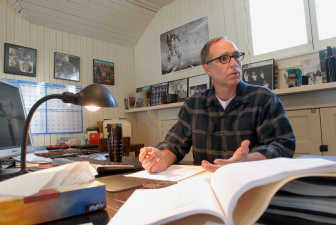
He’s known mostly for comedy, but he wasn’t kidding. Three separate scripts were spread out in his carriage-house office behind his Rockwood Boulevard house. He had been pounding away on his computer all morning long.
He wasn’t breaking the strike – he supports both the guild and the strike. Yet because of his position as a writer of feature films, and thus a contract worker as opposed to a salaried employee, he’s free to continue writing. He just can’t turn in any work until the strike is over.
“To give you a literal for-instance, this (script) here is a movie I sold for Will Smith and Nicolas Cage called ‘Time Share,’ ” said Steilen, leafing through a script. “I sold this about a year and half ago. My contract means I have to turn in one draft, and they futz with it, then I turn in another draft, and the stars get to screw with it, etc., etc. … Well, now I owe them a draft. So I can keep working on it; they just can’t pay me. And they can’t talk to me about it.”
Normally, he said, the producers are constantly on the phone saying things like, “Hey, Mark, Will doesn’t like the part about the kid accidentally peeing on him.” (“Time Share” is a family comedy, with Will Smith as a dad.) During the strike, everything reverts to silence.
Isn’t it odd, working in a void?
“Delightfully,” deadpanned Steilen.
He can also work on new scripts “on spec” (not yet sold). But the longer the limbo lasts, the more serious the repercussions. Every striking writer in Hollywood is working on a new script, and every script will be unleashed on the market the day the strike ends.
“It creates a kind of ice dam, to use a local metaphor,” said Steilen, who is a 1977 Gonzaga Prep grad. “That will deluge the market, just destroy the market.”
Still, Steilen said, the strike is much tougher for TV writers, who are generally salaried employees. Their situation is akin to most other employees during a strike: They are simply out of work.
He knows how serious that can be. During the 1988 Writers Guild strike, he was a novice TV writer on the show “Trapper John, M.D.” He was so green he didn’t even know he was a member (actually, a signatory) of the Writers Guild. He does remember wondering where all of the other writers went.
“He (the boss) comes in and says, ‘What the hell are you doing here? You’re on strike, dumbass, get the hell out of here,’ ” said Steilen. “Everyone else had left at the beginning of the week. But dumbass Mark is sitting in his office all week, saying, ‘It’s kind of lonely in here.’ “
The strike was so devastating that he ended up taking a job teaching English and wasn’t able to break back into scriptwriting for many years. Today, with an established career, he’s much less vulnerable – but still nervous.
When will he start getting really nervous?
“Last August,” he quipped. “I’m always nervous.”
Steilen is best known as a script-doctor for movies such as “There’s Something About Mary” and “Dumb and Dumber,” but he has also written many of his own screenplays. In fact, Steilen and collaborator Jess Walter, the Spokane novelist, may have the distinction of selling the last property in Hollywood before the strike deadline.
Here’s how it happened: He and Walter had been working on a pitch – a story outline – for a movie called “Teach,” about a burned-out teacher who organizes his detention students into a heist squad. Steilen and Walter had even received some interest from Jack Nicholson. So, three weeks before the strike deadline, Steilen and Walter went to Hollywood to pitch the idea to some studios.
They sensed that the studios were reluctant to buy an idea that still lacked a script, with a strike looming. So Steilen said to Walter, “We can knock this script out and then, when they hear it’s already finished, they’ll have no strike worries.”
They came back to Spokane, holed themselves up in Steilen’s office for three weeks and pounded out the whole thing.
“It’s the fastest script I ever did,” said Steilen. “And then we said (to the studios), ‘And by the way, the script’s done.’ Bam, suddenly they did our deal that day.”
Steilen said he was told it was “the last sale in Los Angeles” before the deadline. He has no way of verifying that, however.
“It could be B.S., but it’s a fun story, anyway,” said Steilen.
So now Steilen has plenty of existing projects to fiddle with. He and Walter are also working on a script on spec about some aging hard rockers who suddenly find themselves stars of the kiddie music scene. Think Keith Richard turning into a Wiggle.
Steilen was raised in Spokane and originally had plans to be a poet.
“My father was a Jesuit-educated intellectual who thought movies were for sub-mentals,” said Steilen. “(Pause) And has been proven correct.”
He went to college at the University of Washington, University of Massachusetts, the University of Southern California and the UCLA film school.
After that first abortive TV writing attempt, he spent time teaching college English in San Diego and then slowly made his way back to Hollywood, partly with the help of his old G-Prep pal, Julia Sweeney.
Steilen honed his craft and cultivated relationships. By the mid-1990s he became known for his ability to adapt an existing script for a specific star, i.e., “Dumb and Dumber” for Jim Carrey. He also wrote and directed his own movie, “The Settlement,” starring John C. Reilly, in 1999 for HBO.
Then, in 2002, he moved to Spokane with his wife Carrie and two children. He wanted to come back home, but he was nervous about how it would affect his career. Would he disappear from the Hollywood radar?
“Smartest career move I ever made,” he says now. “Suddenly, when I wasn’t in town, I became so much smarter.”
Hollywood has been throwing plenty of work his way, but if the strike doesn’t end soon, that could dry up. And for TV writers, the work has already dried up.
“Sometimes it sounds like people are making fortunes,” said Steilen. “But those shows come and go so fast. You might get paid well for a year and not have a job for three or four years. It’s a high risk business, and the guild mitigates that risk. I’m a supporter of the union and a supporter of the strike, but do I wish it never happened? Yes.”