
Video variety
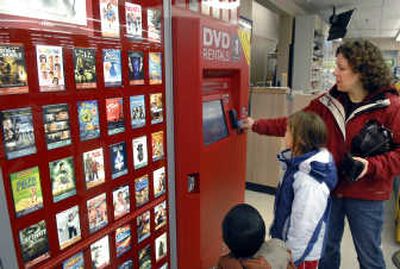
At a new North Spokane video-rental store, customers won’t encounter legions of listless teenage clerks or serpentine racks of movies.
Patrons step up to an ATM-like machine, insert a plastic card and type in a pin number, using a touch-screen to choose from dozens of newly released movies and video games. Once selected, discs eject from a slot. And store members can access the shop 24-7.
Since opening in mid-October, the automated video-dispensing machines at Videomatic, 9327 N. Newport Highway, already have attracted roughly 400 customers, said owner Scott Gardner. While an employee handles member signups and oversees a selection of snacks, video-game accessories and apparel during daytime hours, the shop requires fewer staffers and has perks not found in traditional outlets.
“We wanted to have a mix between the best of traditional video stores and online renting, and offer people instant gratification,” said manager Andrew Campbell.
Automated rental kiosks, which also have sprung up inside local grocery stores, are the latest offering in the brick-and-mortar facet of the crowded, highly competitive rental arena.
Their appearance runs counter to the in-store trend. While mom-and-pop outlets continue in outlying areas, they have all but disappeared in Spokane. Large rental chains continue to see declines and consolidation as more people switch to ordering movies through the mail, watching on-demand movies online or buying discounted discs at big-box stores.
Nationally, video-rental spending could total an estimated $8.3 billion this year, compared with $8.4 billion last year, according to Adams Media Research. Spending in recent years has declined from a high of $10.4 billion in 2001.
“The pie is being sliced thinner and thinner,” Gardner said. “The only way to get a video used to be to go down to the video store and pick up a VHS tape.”
An automated option
While DVD-dispensing machines are popular in Europe and Asia, they’re still catching on here. Only 5 percent of U.S. DVD renters have used a kiosk, but 60 percent are interested in trying one, according to Entertainment Merchants Association, an industry group.
“I think it could bring some consumers back into the market,” said Carrie Dieterich, vice president of marketing and industry relations for the association.
And DVD-kiosk firms such as Redbox Automated Retail LLC have high hopes for the market, estimating they could make up $1 billion to $3 billion within five years, according to the association.
Oakbrook Terrace, Ill.-based Redbox operates 14 kiosks in Albertsons grocery stores in Eastern Washington and North Idaho.
A joint venture by McDonald’s Corp. and Coinstar Inc., Redbox recently boasted it has installed 6,000 kiosks nationwide, including in McDonald’s eateries.
Chains such as Blockbuster and financially beleaguered Movie Gallery Inc., which owns Hollywood Video, have followed suit, testing kiosks in limited locations.
Videomatic’s two primary machines can hold about 6,000 movies, representing about 5,000 titles when fully stocked, Gardner said. The store saves about 30 percent on real estate because of its smaller footprint and about 30 to 40 percent on labor, Gardner said.
New releases cost $2 for the first day and $1 each additional day, while older titles cost half that. Users can “charge” their cards using cash or credit and debit cards. Videomatic also offers monthly subscription plans.
Videomatic has just three employees. During the day, a clerk can add money to customers’ accounts or assist with movie selections. At night, customers swipe their cards to enter the shop.
Redbox units hold more than 500 discs, accounting for about 100 to 150 new releases, according to the company.
Redbox, which moved into the area in April, charges $1 per night and accepts only credit cards. Renters can return titles to any Redbox location, the company says.
“While most grocers agree that DVD rental is a valuable service, many have struggled to support traditional video rental departments due to space and labor requirements,” said Gary Lancina, Redbox’s vice president of marketing. “Redbox offers retailers a streamlined solution, requiring no staffing support and only 18 square feet of retail space.”
Both companies allow users to check machines’ stock online and reserve titles for pickup.
Aaron Start of Spokane rented the 1997 Mel Gibson movie “Conspiracy Theory” on a recent trip to Videomatic. He switched from using Blockbuster.
“It’s the cheapest,” said Start, 19. “And it’s high-tech, and I like that.”
Neither automated service rents high-definition HD DVD or Blu-ray discs, which offer better picture quality than DVDs and can be ordered through Netflix or found at some Blockbuster stores. Videomatic hopes to add some early next year, and it plans to insert older titles over time, Campbell said.
Ed Javorka, of Hayden, Idaho, has used a Redbox at a nearby Albertsons because of its price and proximity.
“Selection, however, is generally poor,” said Javorka, 74. “Mostly junk stuff for tweens and young males.”Videomatic also may be a boost for movie junkies: New releases become available Tuesdays at 12:01 a.m. instead of later when stores open.
The price and convenience of Videomatic appealed to Al Teuben, who signed up after visiting the store with his son.
“I thought it was very interesting because it’s all so modern, and there’s no crowd in here right now,” said Teuben, 46. “I just want to get my movie and go.”
Gardner also owns the local Videomatic’s parent company, Inland Video Supply LLC, a Dalton Gardens, Idaho, outfit that supplies grocery-store rental shops. After researching machine options, he settled on Videomatic, a partnership between a Spanish company that supplies software and an Italian firm that makes the machines. It has about 4,000 machines worldwide, he said.
Inside the machines, a robotic arm grabs movies from thousands of plastic slots, returning them to nearby open spaces once they’re returned.
As a Videomatic-brand distributor for the Northwest, Gardner said, he hopes to have more kiosks and stores in place next year.
Future kiosks elsewhere could allow people to burn copies of discs on-demand — a method that could expand retailers’ stock. Walgreens, the nation’s largest drugstore chain, in October announced plans to launch DVD-burning kiosks that could make discs in about 15 minutes, according to news reports.
Mom-and-pops
Faced with increasing competition, many independent stores have diversified or gone out of business.
“The local rental market has slowly been kind of going away,” said Ray Pipella, president of Video Source Distributing, of Spokane.
The company once supplied movies to more than 150 independent stores, he said. Now it serves about 60, and the company’s big business is with military contracts for stores on bases around the world.
To vie with big-box stores like Best Buy and Wal-Mart that sell movies for prices close to what it costs to rent, small stores have added other features, Pipella said.
Suncrest Video in Nine Mile Falls stocks about 1,800 titles, roughly half its former selection, and sells gifts and balloons, said owner Sonya Allen.
“I see mom-and-pops only being in niche markets,” Allen said. “They’re not going to survive any other way.”
Former Deer Park video-store owner Tim Walsh, 51, shut down his traditional business and started a home-delivery service after Movie Gallery opened there in 2003, he said. Now, with an inventory of about 80 new releases, he delivers to about 20 customers, he said.
“It’s a lot more fun,” he said. “I miss my store, but yet I love the freedom of not having to have a door open all the time.”
“I think ma and pas will always be there for people to just come down and see the titles,” Pipella said. “It’s something they’ve been used to living with for the past 15 years.”