
Past, present local major league players react to Mitchell Report
Several former major league baseball players in Spokane aren’t shocked by the early revelations in the Mitchell Report.
“Overall, disappointed, and disillusioned a little bit,” said Jack Spring, who was watching the results of baseball’s steroid investigation unfold on television Thursday afternoon. “Not just in baseball but in all athletics, individuals trying to gain an advantage through illicit means.”
Casey Parsons painted a gloomier picture.
“I was listening to the radio, listening to the names and I was thinking to myself, ‘For every name on there, a lot of people are sighing with relief their name wasn’t on it,’ ” he said. “I’m not surprised at all. In the competitive nature of sports, if you’re doing it I better do it or I might not be able to keep up with you.”
It really hit home for Kevin Stocker.
“Looking at the names, the thing that stuck out most was they’re all guys I played with and against,” said Stocker, who played with three teams in an eight-year career that ended after the 2000 season. “Some are my friends. They’re still nice guys.”
Spring, who went to Lewis and Clark High School, pitched for seven different teams over eight seasons until retiring in 1965.
“I’m very disappointed,” he said. “So many players have taken advantage and really harmed the integrity of the game. I knew it was extensive (and) assumed it would involve some big names. I guess I’m mostly surprised by the extent. I’m anxious to see the bigger report.”
He’s not sure how the game will be affected.
“That’s a difficult question,” Spring said. “It will be interesting to see how the commissioner reacts, particularly in situations involving record-setting people. … Hopefully, this report will open the eyes to our current players and they say, ‘Hey, we can’t go on like this.’
“There will probably always be a few who want to break the rules. Hopefully, the vast majority of them will recognize what is happening and therefore reject these drugs.”
Parsons, a University High School and Gonzaga University graduate, was more pessimistic.
“What the report proves is baseball had a far-reaching problem, not just a couple of guys,” said Parsons, who spent part of four seasons in the majors, beginning with Seattle in 1981, and managed in the minor leagues for six seasons until retiring after the 1994 season. “I think at this point in time there’s always going to be somebody trying to get an edge. With technology the way it is, there’s always going to be some new drug coming down the road and a player willing to try it if it they won’t get caught.
“It won’t help to punish anybody now; they have to go forward. (The owners and players’ union) are going to have to work together and make sure guys aren’t using. The scary thing is the kids. They watch the players. It really messes you up when you’re still growing. It’s more important to make sure the kids don’t think it’s something that’s acceptable.”
Stocker, a Central Valley and University of Washington product, agreed.
“Baseball needs to tighten things up now, make the punishment fit the crime,” he said. “You can’t punish now – what’s past is past, you can’t do anything about it. … If they lied, that’s a whole other issue.”
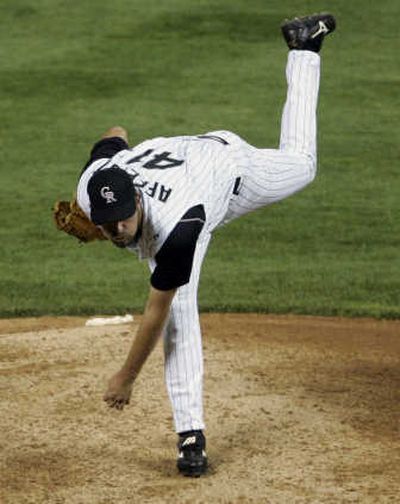
Northwest Christian graduate Jeremy Affeldt, a free agent who pitched for Colorado in the World Series this year, has a different perspective as an active player.
“Nothing really shocks me when it comes to baseball,” he said. “Unfortunately, steroids and HGH have been a part of the game. Do I consider it cheating? You’d have to give me a good reason why it’s not cheating. From what I know of steroids, it’s cheating.”
Affeldt pointed out that HGH can be prescribed by a doctor for healing purposes and, although banned by baseball as an enhancement, is not illegal.
“If every fan will sit down and ask, ‘What did I want to see?’ They want to see power, home runs,” said Affeldt, who has been in the majors since 2002. “Steroids aid in that.”
His concern is also with children.
“What I fear for the fans is they have kids and all they’re hearing is cheating. I’m concerned with the role model aspect,” he said. “I want kids to know can get to big leagues by natural talent. … Unfortunately, kids are going to get the wrong message.”
As for how the fans take it, Affeldt is hoping for the best.
“Fans going into next year just wearing out these guys whose names came out … that’s not needed,” he said. “If he made the mistake, he made the mistake. Don’t hold it over his head. Everybody makes mistakes. Some of the athletes in our arena gave into (the temptation).”