
A true saint
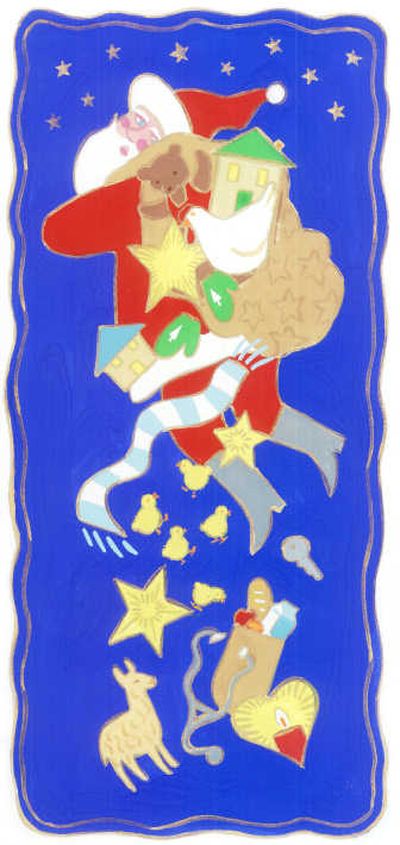
Dandi Daley Mackall thinks Santa Claus needs a makeover.
No, it’s not his weight, although the little round belly is getting bad press as a not-so-great role model for the kiddies. And the pipe is OK – how many kids are going to be drawn to pipe-smoking by the jolly old elf?
What he needs is moral support, according to Mackall, some help in bringing back the more wholesome image of St. Nick that’s been missing in recent film depictions of Santa as a harried business executive in the new movie “Fred Claus,” a foul-mouthed phony in the movie “Bad Santa” of a few years ago, and a co-opted, unwilling human in the Tim Allen “Santa Clause” movies.
“Why should we spend our time and money fanning the flames of the poorest side of his image?” asked Mackall, who wrote a children’s book, “The Legend of St. Nicholas: A Story of Christmas Giving” (Zonderkidz, $15.99).
While Mackall’s book is distinctly Christian, published by a Christian company, the message of giving rather than receiving transcends any particular religion, she believes.
And she’s not the only one who feels that Santa is becoming the object of ridicule or parody in modern popular culture.
“Some people are growing up with the attitude that it’s clever or cute to parody or mock Santa. Nothing’s sacred anymore,” said Robert Hoffman, a collector of Santa Claus memorabilia and the author of “Postcards from Santa Claus” (Squareonepublishing), a collection of images from the mid-19th century and beyond. “I think people are angry.”
The original Nicholas was a 4th-century bishop in what is now Turkey, and from early on he was associated with gift-giving to the poor. One of the most famous legends is his gift of dowries to three poor sisters who could not afford to marry and were in danger of becoming prostitutes. The legend is depicted in a 14th-century painting by Abrogio Lorenzetti.
Scholars believe St. Nicholas picked up attributes from the pagan god Odin, who celebrated Yule each year with a great feast. Children would leave their shoes, filled with straw for Odin’s horse, Sleipnir, and in the morning find gifts or candy left by the god. In the Christian version, Sinterklass comes on Dec. 6, St. Nicholas’ feast day, to leave treats in children’s shoes.
That image morphed into the American version in the 19th century, starting with Clement Moore’s “The Night Before Christmas,” published in the 1820s. His robes became red, he put on a lot of weight, and he showed up on Christmas Eve. But the gift-giving was still central.
“He was always shown giving gifts. Harper’s magazine showed him bringing food and gifts to the troops during the Civil War,” said Hoffman, a professional dealer based near Rochester, N.Y., referring to Thomas Nast’s famous image of Santa.
Soon the burgeoning advertising industry latched onto Santa, famously in the Coca-Cola advertisements from the ‘30s.
“He’s always pushing things. I think they’d use him to sell subprime mortgages if they could,” Hoffman laughed.
Even so, Hoffman said, Santa’s image has always been bigger than any product he was pushing.
It’s just been in the last few decades or so that Santa has developed an ironic dimension. And that coincides with the widespread feeling that Christmas has become overcommercialized, with hype beginning in October, with emphasis on materialism and consumption, according to Hannah Levertoff, a psychologist and chief academic officer of Newbury College in suburban Boston.
“It’s really a cultural expression of how we’re feeling about life in general,” she said. “Peace on Earth and goodwill to men is swallowed up by shopping.”
It’s no accident that Mackall’s book opens in a store. The main character, Nick, is shopping for Christmas presents for his two little brothers but hoping to buy himself a CD when he hears a store Santa tell the story of the original St. Nicholas. Inspired, Nick also buys a toy for the toy drive for needy kids and discovers the delight of giving.
That delight is still very close to Santa Claus, according to Robbie Blinkoff, an anthropologist with Context-based Research Group in Baltimore, a market research company.
Like a good anthropologist, Blinkoff hung out with some local Santas to find out more about whether the old guy still had some magic left.
“Christmas is so overcommercialized, and we’ve lost the joy of giving,” said Blinkoff. But he was surprised that the two Santas he spent time with at parties and community events such as parades truly did express the spirit of the holiday.
One of the Santas refused payment, and the other used his earnings to buy gift certificates for needy children, he said.
“These guys are all about compassion. One little boy asked one, ‘Can you bring my daddy back?’ and and I thought, ‘That’s it! What Santa represents is still there!’ ” Brinkoff said.