
Sharpton’s renaissance
NEW YORK – Even by his own frenetic standards, the Rev. Al Sharpton has had a busy 12 months. Late last year was the police shooting in Queens of Sean Bell, an unarmed black man leaving a bachelor party, and Sharpton organized the protests. There was the spring controversy over racially insensitive remarks by Don Imus, with Sharpton leading the calls for Imus’ firing.
Sharpton put together a march in Jena, La., in support of six black teenagers jailed in the beating of a white student, and he held a protest rally outside the Justice Department in Washington to demand more prosecution of hate crimes.
He found time to take on the hip-hop industry for denigrating women and using racial epithets in lyrics. He was in Chicago recently threatening to boycott that city’s bid for the 2016 Summer Olympics unless more is done to stop police brutality.
And now he is being wooed by the leading Democratic presidential candidates, all of whom seek his endorsement. “I think this has been a banner year, to say the least,” said Sharpton. “This year proved the real revival of civil rights activism.”
For Sharpton, the pace of his past year and the pleas for support from presidential aspirants provide the answer to the question some are posing: How does Al Sharpton remain relevant in a Barack Obama world?
Obama, a Democratic senator from Illinois, has emerged as the first black politician with a serious chance of capturing his party’s presidential nomination and the White House. And there have been other notable, if quiet, political successes, such as Deval Patrick becoming the first African-American governor of Massachusetts, and David Paterson being elected New York’s first black lieutenant governor.
Those successes have led some to suggest that the country is ready to embrace, in the post-civil rights era, a new kind of black leader, one who transcends race and appeals to as many white voters as black.
Sharpton has “been eclipsed, because Obama puts guys like Sharpton in the shadow,” said Fred Siegel, a historian of New York City at the Cooper Union college in Manhattan. “Suppose Obama is elected president. He’s terrible for Sharpton, because that takes away Sharpton’s job. He’s a kind of racial ambulance chaser. It’s hard to engage in that game if there’s another powerful African-American politician.”
But Sharpton has thrived this year with his high-decibel activism, even in the face of a federal investigation of his 2004 campaign finances. In an interview punctuated by interruptions from his cell phone, he scoffed at the notion that he is being overshadowed or is any less relevant.
“It borders on insulting to say that because some blacks are doing well in politics, we don’t need organizations to protect civil rights,” he said. “The role I play in American life and the role that Deval Patrick and Barack play are two different roles.”
He also calls that view of his diminishing importance a misreading of modern black history. “We’ve always had blacks on the inside and blacks on the outside,” he said. “You always had blacks so-called in the system and blacks outside.”
In New York, his home base, Sharpton remains a polarizing figure for many, best remembered for championing the cause of Tawana Brawley, a black teenager who said she was abducted and raped by six white law enforcement officials but whose claims were later discredited.
In May, Sharpton again showed his penchant for inflammatory statements when he said of Republican presidential hopeful Mitt Romney, “As for the one Mormon running for office, those who really believe in God will defeat him anyways, so don’t worry about that.”
The statement prompted Romney to reply in a television interview: “I can only, hearing that statement, wonder whether there’s not bigotry that still remains in America.”
But Sharpton has survived to become a political power broker of sorts. Once shunned for his street antics, jogging suits and bling, he is now courted by local and state politicians who dutifully troop to the Harlem headquarters of his National Action Network every January for his celebration of the Rev. Martin Luther King Jr.’s birthday.
“He seems to have evolved into a new respectability, at least in the city,” said Norman Siegel, a lawyer and former director of the New York Civil Liberties Union, who has known Sharpton for 20 years. Regarding the King celebrations, Siegel said, “Every single elected official, no matter what they said about him in the past, they’ll show up.”
But Siegel said Sharpton still has a negative reputation among many white New Yorkers; Siegel has acquaintances who ask him, somewhat derisively, whether he is still friends with Al Sharpton.
Nonetheless, Sharpton has managed to maintain his clout even while continuing to face controversy, most recently an FBI and IRS investigation into financial records from Sharpton’s 2004 presidential campaign. Earlier this month, federal agents served early-morning subpoenas on eight of Sharpton’s aides, ordering them to produce records and documents for a Brooklyn grand jury.
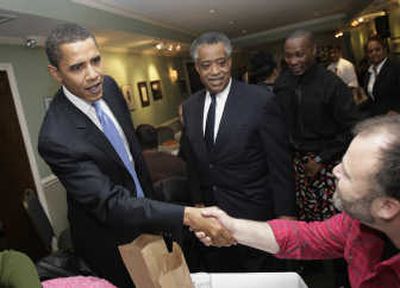
Sharpton dismissed this latest probe as government harassment resulting from the protest he led last month outside the Justice Department.As evidence of his continued relevance on the political scene, Sharpton pointed to the presidential candidates chasing his endorsement. He planned to fly to South Carolina earlier this month to meet former President Bill Clinton until his flight was canceled. Last month, he shared a meal with Obama at Sylvia’s, a Harlem soul food restaurant.
“On the one level, they say we don’t matter. On the other level, they want to know who we’re endorsing,” Sharpton said.
Sharpton said he is going to decide among Sen. Hillary Rodham Clinton of New York, Obama and former Sen. John Edwards of North Carolina. And like much of the black community, he is torn about which way to go.
“I really haven’t decided,” he said.