
Strong currents thwart Delaware River recrossing
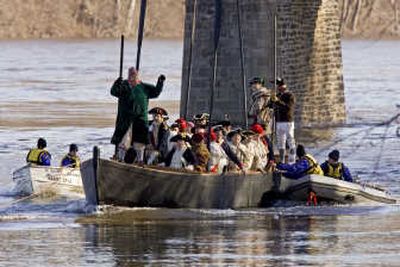

WASHINGTON CROSSING, N.J. – This George Washington could not make it across the Delaware River.
Ronald Rinaldi III was prepared to play the role of the military leader whose daring Christmas crossing led to a rout of British-led forces and revived the downtrodden Continental forces.
Rinaldi, 45, had taken part in every re-enactment of Washington’s crossing of the Delaware since 1976, amassed more than 500 books on the American Revolution and earned a degree in U.S. military history.
But this year, he and his fellow re-enactors were done in by the river’s strong currents.
As Rinaldi and hundreds of spectators watched, the first boat that attempted the short voyage from Pennsylvania got carried downstream. A rescue craft had to snare it. Three boats had trained to cross the river this year in the 55th annual re-enactment, and dozens participated.
“It wouldn’t be a Christmas Day without going down there,” Rinaldi said.
The rowing portion of the re-enactment has always been at the mercy of the river. Past events were scrapped when the river was too fast or it was too windy.
Hilary Krueger, director of Pennsylvania’s Washington Crossing Historic Park, which hosts the re-enactment, said the decision is usually made before any boats go out, but there have been times when a boat has had to be rescued.
Rinaldi, who was playing the role of Washington for the first time, was chosen by a panel of three experts on the crossing and will portray him for two years.
The county crime scene investigator became interested in Revolutionary War history after taking part in the 1976 crossing when he was 14.
In Christmas 1776, some 2,400 soldiers, 200 horses and 18 cannons ferried across the cold Delaware River.
The Continental soldiers, many ill-prepared for the cold weather and poorly trained compared with the troops they were about to face, then marched eight miles down river in blizzard-like conditions.
They soundly beat the German mercenary soldiers based there, capturing 1,000 prisoners, killing 30 troops and only losing two Continental soldiers – and both of them froze to death.