
More to come for Walker
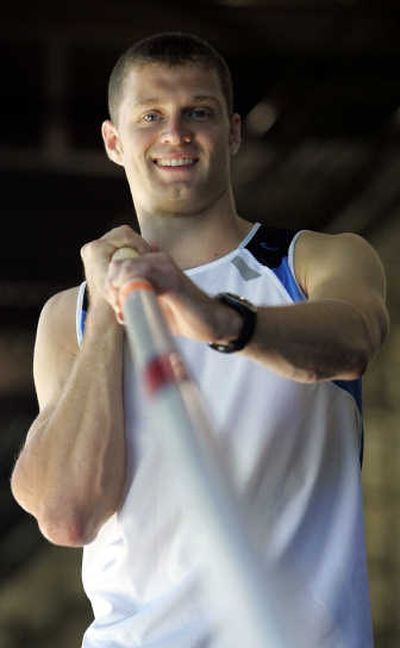
The punch line to the old “How do you get to Carnegie Hall?” joke wasn’t supposed to be a vehicle for irony.
“Practice, practice, practice,” is how the gag goes. But to Brad Walker, it’s really funny.
The University High School graduate made it back to the Carnegie Hall of track and field in 2007 – finishing the year ranked No. 1 in the world in the pole vault by the sport’s bible, Track and Field News.
But practice – at least traditional practice – had little to do with it.
Indeed, two bulged discs in his back had him on the verge of writing off the pre-Olympic year. That obviously would have been premature, seeing that he would win his first outdoor world championship in Osaka, Japan, in August – a feat made all the more startling by the process that led to it.
“I practiced the pole vault six times in 2007,” said the 26-year-old Walker. “Six times. The majority of pole vaulters would vault in practice six times in two weeks, or three. So I was going from meet to meet trying to correct things technically in competition when I didn’t have the actual vaults under my belt in practice.”
On the surface, it appeared to impact him not at all.
He opened the season with three strong meets in Australia, including a world-best mark of 19 feet, 6 1/4 inches in Brisbane. Later, he won a second U.S. outdoor championship to earn a spot on the team to Osaka, and wrapped up the year with another big victory – a 19-4 1/4 leap at the World Athletics Final in Stuttgart.
That report card made him an obvious choice for No. 1 in the TFN rankings – and, by extension, an early gold medal favorite for the 2008 Olympics in Beijing, though there is no such thing as a prohibitive favorite in an event as volatile as the vault.
Still, Walker – who missed out on making the Olympic team in 2004 – knows the heat is on.
“I think for all Olympic sports – track and field, swimming, gymnastics, whatever – the Olympic year always means a little more,” he said. “A lot of athletes structure their training around Olympic years. It’s the year the spotlight is on track and field, and knowing that the sport this year gets more exposure and support puts on more pressure.”
Walker long ago proved himself as a pressure jumper – whether as a collegiate (two NCAA indoor titles) or on the international level (2006 World Indoor champ, 2005 World Outdoor silver medalist). But the 2007 season was further evidence above and beyond.
The disc issues began to disrupt his performance during the outdoor season prior to the U.S. championships – though not because it left him out of shape.
Walker had begun training with a new coach, Dan Pfaff – who has worked with, among others, former sprint great Donovan Bailey. Pfaff was able to steer Walker away from squats and other heavy weightlifting to alternatives like sprint training, shot throws and different lifts that put less stress his back.
“It was important to know that I was in shape to jump high,” he said, “even if I hadn’t done it in practice.”
But doing it in meets was becoming problematic “because there were a lot of aspects of my vault I’d like to tweak and make better and without having actual practice sessions, I was trying to change them during meets. And during most of the U.S. outdoor season, they weren’t working. The results of those meets were pretty bad. At one point I just said, ‘This isn’t working – I just need to do what I’ve done in the past.’ “
That’s what got him through nationals – and launched a successful run of vaulting in Europe before the disc problems sidelined him again for a month leading up to Osaka.
“If you were to take a football or basketball player and not let them do their sport for a month before a championship game, they’d go in with a little anxiety,” he said. “I knew I was in good shape, but it gets to you a bit. Luckily, I was able to shake some of the rust off during the qualifying round and use it for practice for the finals two days later.
“If it had been a one-day competition, the outcome wouldn’t have been the same.”
Walker is realist enough to see what could have happened, and pragmatist enough to understand what did. Heading into the Olympic year, it’s given him even more confidence in Pfaff’s techniques and faith in his fitness and adaptability. Now back home in Mountlake Terrace, Wash., in the house he bought two years ago, Walker is preparing for what will be an abbreviated indoor schedule (just four meets) and an outdoor campaign in which he will forego his usual European trip before the U.S. trials.
“This past year was really surprising and different,” he said. “If you look at the record – how I was competing and how I did – it was my best year to date. At the same time, I wasn’t able to have a personal best and that was the first time that’s happened since my junior year of high school.
“There were a lot of mixed emotions – I was ready to write the season off and get ready for 2008 and then I’m the world champion and I’m taking a shot at the world record in my last meet of the year. I can take a lot out of this season, including the feeling that there’s a lot more to come.”