
Yellowstone not out of danger
BILLINGS – More than four years after Yellowstone National Park was taken off an international list of threatened places, officials there continue to address issues that put it on the list in 1995.
This week, Yellowstone officials released a nine-page draft report intended to address six key areas of concern – such as bison and water quality – identified by the U.N. World Heritage Committee. A notice of the report appeared in Wednesday’s Federal Register.
The World Heritage Committee in December 1995 placed Yellowstone on an international “in danger” list, citing several threats to the park’s natural and cultural resources.
The chief threat at that time was the New World Mine, proposed just outside Yellowstone near Cooke City. In 1996, the federal government bought out the interest of Crown Butte Mines, essentially eliminating the chance that the mine would reopen. Since then, much of the land has been the subject of an intensive cleanup and reclamation project. The work is now near completion.
With that issue being dealt with, the World Heritage Committee lifted Yellowstone’s “in danger” designation at a meeting in Paris in July 2003. Committee members, though, said five other significant threats to Yellowstone remained.
For the first time in removing a site from the danger list, the committee required the United States to report back on progress with issues at Yellowstone. Specifically, they wanted updates on threats to bison and Yellowstone cutthroat trout, along with information on roads, water quality and visitor issues, including the controversy over snowmobiling in the park.
Yellowstone officials, who were not immediately available for comment, are accepting public comment on the draft until Jan. 25.
The report updated several issues identified in 1995:
Bison
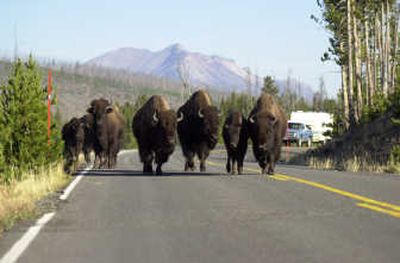
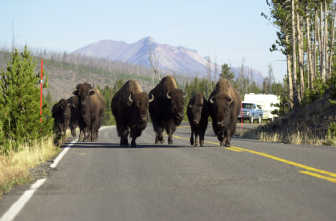
Brucellosis continues to be the key issue with Yellowstone’s bison population. In 2000, several state and federal agencies signed a management plan intended to reduce the risk of bison spreading the disease to cattle outside the park while maintaining the park’s bison herd.
Since then, there have been several years when large numbers of the bison herd have been hazed and, in many cases, sent to slaughter. In recent years, the population has remained between 3,000 and 5,000.
“While many people in the local and national conservation community do not support the plan, in the last five years the core Yellowstone bison population (has been at) historic high levels,” the report said.
Some uninfected bison have been given a brucellosis vaccine, and a study has been launched looking for the best options for giving vaccines on a large scale inside the park.
Also, more than 100 bison calves have been taken to a facility in Gardiner to help researchers devise a protocol for certifying disease-free bison.
Cutthroat trout
The native trout have been under attack for years by non-native lake trout, which eat the smaller cutthroat and have put a deep dent in their numbers in Yellowstone Lake. The lake trout not only threaten to make Yellowstone cutthroat functionally extinct but also change the diet for some 42 species that eat it and the $36 million sport fishery once associated with it.
Over the past 12 years, nearly 270,000 adult and juvenile lake trout have been pulled from the lake in gillnets as part of an aggressive May-to-October campaign.
“Despite this effort, lake trout in Yellowstone Lake are still present in high numbers and evidence suggests that the population is continuing to expand,” the report said.
The cutthroat has been “slow to respond” to the gillnetting work but there have been a few hopeful signs including a few first-time spawning fish in several streams around the lake.
The U.S. Fish and Wildlife Service in 2006 reiterated its earlier decision not to place the fish on the endangered species list.
Water quality
The pressure to accommodate nearly 3 million Yellowstone visitors a year puts a strain on the infrastructure.
In 1995, the World Heritage Committee voiced concern about old and outdated wastewater treatment plants, leaky fuel tanks and other failing systems. Since then, about $22 million has been appropriated for water and sewage projects, Yellowstone officials said.
All of the park’s fuel storage tanks have been replaced, and new wastewater treatment plants have been installed at Old Faithful and Norris Geyser Basin. More projects remain and are dependent on funding, the report said.
Park roads
Yellowstone’s 478 miles of roads were considered deplorable in 1995, damaged by the volume, size and weight of vehicles rumbling through the park.
Park officials worked with the Federal Highway Administration to develop a long-term plan to improve the roads – making them safer, better for driving and less prone to degradation, park officials said.
Despite several road projects over the years, fixing the roads has been a slow process because of the short construction season and the need to have road reconstruction “be reasonably compatible with summer visitors,” the report said.
Visitor use
Officials in 1995 worried about the effect of an increasing number of visitors in the summer and winter on Yellowstone’s cultural and natural resources.
Yellowstone officials said that pressure is lessening in part because of a reduction starting next winter in the number of snowmobiles allowed into the park. Spring, summer and fall visitation has leveled off, park officials said.
As a way to lessen the effects on the environment, winter vehicles have to meet noise and pollution requirements and more efforts are being made to use alternative fuels in park vehicles, recycle, reduce garbage and increase composting.
“Visitor growth appears to have diminished as an issue in the eyes of many,” the report said.