
Further strife in Iraq foreseen
WASHINGTON – A long-awaited National Intelligence Estimate on Iraq, presented to President Bush by the intelligence community Thursday, outlines an increasingly perilous situation in which the United States has little control and there is a strong possibility of further deterioration, according to sources familiar with the document.
In a discussion of whether Iraq has reached a state of civil war, the 90-page classified NIE comes to no conclusion and holds out prospects of improvement. But it couches glimmers of optimism in deep uncertainty about whether the Iraqi leaders will be able to transcend sectarian interests and fight against extremists, establish effective national institutions and end rampant corruption.
The document emphasizes that while al-Qaida activities in Iraq remain a problem, they have been surpassed by Iraqi-on-Iraqi conflict as the primary source of violence and the most immediate threat to U.S. goals. Iran, which the administration has charged with supplying and directing Iraqi extremists, is mentioned but is not a central focus.
Completion of the estimate, which projects events in Iraq over the next 18 months, comes amid intensifying debate and skepticism on Capitol Hill about the administration’s war policy. In a series of contentious hearings over the past two weeks, legislators have sharply questioned Bush’s new plan for the deployment of 21,500 additional U.S. troops and the administration’s dependence on the Iraqi government of Prime Minister Nouri al-Maliki.
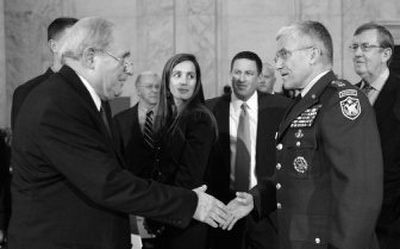
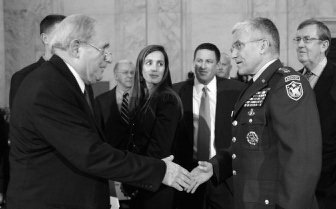
In acid remarks Thursday to Gen. George Casey, the departing U.S. commander in Iraq, Sen. John McCain, R-Ariz., noted that “things have gotten markedly and progressively worse” during Casey’s two-and-a-half-year tenure, “and the situation … can best be described as dire and deteriorating. I regret that our window of opportunity to reverse momentum may be closing.” Casey was appearing before the Senate Armed Services Committee on his nomination as Army chief of staff.
In the same hearing, Casey told lawmakers that President Bush has ordered thousands more troops into Iraq than needed to tamp down violence in Baghdad. He quickly added he understood how his recently confirmed successor, Lt. Gen. David Petraeus, could want the full complement of 21,500 additional troops that Bush has ordered.
Although McCain supports the additional troop deployments, he has proposed a Senate resolution including stringent benchmarks to gauge the progress of the Iraqi government and military. McCain’s resolution and other non-binding, bipartisan proposals that would express varying degrees of disapproval of Bush’s plan will be debated on the Senate floor next week.
Legislators have been equally critical of the intelligence community, repeatedly recalling that most of the key judgments in the October 2002 NIE on Iraq’s weapons of mass destruction were wrong. That assessment concluded that Saddam Hussein had amassed chemical and biological weapons and was “reconstituting” his nuclear weapons program. It became the foundation of the Bush administration’s case – and congressional authorization – for invading Iraq.
“One of the sort of deeply held rumors around here is that the intelligence community gives an administration or a president what he wants by way of intelligence,” Sen. Dianne Feinstein, D-Calif., told Vice Adm. John McConnell, Bush’s nominee as director of national intelligence, during his confirmation hearing Thursday.
Without directly accepting Feinstein’s premise, McConnell replied that the intelligence community had learned “meaningful” lessons over the past several years and “there’s very intense focus on independence.” McConnell and others made clear that the NIE had been subjected to extensive competitive analysis and “red-teaming” to test its conclusions.
Current intelligence director John Negroponte briefed the president on the NIE Thursday, and the document will be made available to Congress early today.
Sources familiar with the closely held estimate agreed to discuss it in general terms Thursday on condition that they remain anonymous and not be directly quoted.