
Coeur d’Alene Homes has long area history
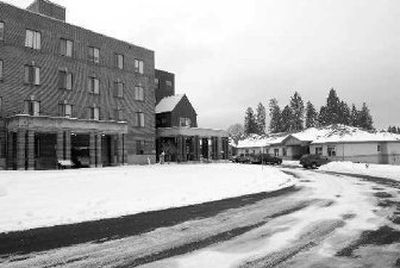
At 91, Pearl Heineman is a veteran of two other local assisted-care facilities, but she finds life in the “new” Coeur d’Alene Homes “a whole lot better.”
“The help here is wonderful. They look in on you all the time to make sure you’re OK. The food is very good, too; it’s always hot. And I don’t have to do a thing. They vacuum my room, change my sheets weekly, and there’s always something to do.”
That “something to do,” she said, includes daily bingo, talks on topics such as health and nutrition, listening to local entertainers, trips for shopping, doctor visits and, “just last week, they loaded up a bus for eagle-watching. I didn’t go, though. I’ve seen eagles before,” she said.
Heineman, a Coeur d’Alene native, has been a widow since her husband, Tom, a 45-year pressman for the Coeur d’Alene Press, died in 1994.
While the building she lives in now is new – dedicated just a month ago – the institution itself is in its 86th year. It’s built on 10 acres once occupied by Coeur d’Alene College, a four-year liberal arts institution founded a century ago.
The land is part of the abandoned Fort Sherman military reservation, donated along with a $25,000 grant by the Coeur d’Alene Commercial Club to the Columbia Conference of the Swedish Augustana Synod of North America.
The college began classes in 1907 but closed its doors 10 years later because its board feared the school wouldn’t be able to weather the turbulence caused by World War I.
The campus then consisted of two large brick classroom buildings, a frame dining hall, gymnasium, the president’s home and several smaller buildings.
They were vacant for three years, but in 1920 an organization called the Rocky Mountain Lutheran Charities Association of Coeur d’Alene purchased the college for use as a home for the elderly.
On June 5, 1921, Coeur d’Alene College became Coeur d’Alene Homes. An information sheet accompanying the dedication program stated, “Your institution is known as Coeur d’Alene Homes. It is not a hospital, an insane asylum or a ‘poor farm.’ It is a home. The primary purpose of this institution is to furnish a comfortable rest home for aged, respectable people who wish to secure for themselves care and comfort in their declining years.”
That mission hasn’t changed.
Longtime Hayden resident Ed Johnson says, from 1928 until last year, family members including his father, aunt, great aunt and a cousin have either lived in or worked in the Homes.
For many years, he said, it was the only “old folks home” between Kalispell and Spokane, and hence had residents from Montana and Washington as well as Idaho.
Over the years, Homes ownership has been assumed by 25 corporate Christian congregations and its mission has continued to “provide compassionate Christian care to adults and older adults in our community needing assistance with the daily activities of their lives,” according to a brochure.
Mike Grabenstein, a former Lutheran pastor who has been the Homes’ administrator since 2000, says the facility welcomes people of any creed, color or nationality.
“By Christian care, we mean we’re following God’s commandment to love our neighbors as we love ourselves,” he explains.
Grabenstein describes the Homes as the only not-for-profit assisted-living community in the area that’s uniquely equipped to care for the physical, mental, social and spiritual needs of its residents.
The now-closed “old” Homes building, a 36-bed facility, still stands, and Grabenstein says plans call for a partnership with the Dirne Clinic and its eventual evolution into a medical facility for low-income elderly persons.
The new building houses 69 beds – 35 for assisted-living residents in studio and one-bedroom apartments and 34 for those suffering from Alzheimer’s or other forms of dementia. Those people are accommodated in private or semiprivate rooms.
About 35 persons staff the facility, including nurses and dietary, maintenance and housekeeping personnel.
Fees, which include board, room and all services, are dependent on the size of the accommodations and the level of care needed. Assisted living units cost from $2,600 to $3,200 per month, and those for residents with dementia range from $2,900 to $3,500. Care beyond the “moderate” level is priced higher.
Grabenstein said Coeur d’Alene Homes receives funding from residents’ fees, grants, corporate and congregational donations, and profits from its thrift store. About 75 percent of the residents are on Medicaid.
Currently about 60 percent of the rooms are occupied, and there is no waiting list.