
Saving, reclaiming elk habitat
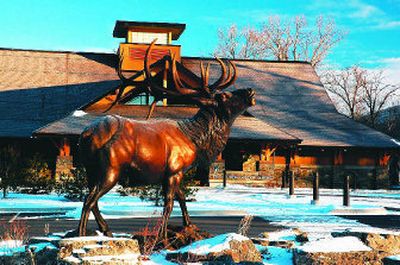

The Rocky Mountain Elk Foundation visitor center recently opened in Missoula, for the benefit of hunters, nonhunters and wildlife throughout the country. Nonhunters who are wildlife- and land conservation-minded may want to visit and join this group.
Why should nonhunters join an organization that promotes elk hunting? The answer can be found at the center.
The Rocky Mountain Elk Foundation’s roots have an Idaho connection. Twenty-one years ago, four men from Troy, Idaho, came to the conclusion that ducks, trout, sheep and white-tailed deer all had organized groups protecting them. But elk and elk habitat were not being protected.
The four avid hunters had plenty of vision and no money, but they persisted and learned how to organize a nonprofit enterprise. Remarkably, the Rocky Mountain Elk Foundation now has more than 150,000 members, 11,000 volunteers and 150 employees. The group also has a new $14 million, 70,000-square-foot facility in Missoula.
They have a compelling line of reasoning which is called a model for wildlife conservation. They are hunters and fishermen, but with 2,500 acres of ranches, forests and open space being lost every day to development and other uses, elk habitat and other wildlife are losing out. The elk foundation is working toward saving and reclaiming elk habitat throughout the country.
The members and volunteers are making a difference. Working on its own as well as partnering with other conservation groups, the foundation has permanently protected more than 1,000 square miles and enhanced 5,200 square miles of critical wildlife habitat. Hunting and fishing license proceeds and donations allow the foundation’s commitment to ensuring the future of elk and other wildlife. Avid hunters recognize good hunting requires that elk need wild, undisturbed land to reproduce and grow. Other wildlife will benefit along with the elk.
The wildlife we enjoy in North Idaho is not here by accident. Hunting and conservation have been partners for many years. About the time of the Battle of the Little Bighorn, 1876, there was serious commercial killing of our nation’s wildlife. Wolves, beaver and bison were not the only animals hunted almost to extinction.
It’s been called “The Elk Holocaust” with entire states losing their elk herds to commercial hunting. Legendary conservationists like Teddy Roosevelt, John Muir and George Grinnell were relentless advocates in finding ways of protecting wildlife and land.
The Rocky Mountain Elk Foundation is continuing that tradition. It has funded the transplanting of elk from Yellowstone National Park and from Canada to areas of the country that supported elk 150 years ago. Elk have been reintroduced to Kentucky, Tennessee and Wisconsin. Thanks to the elk foundation, elk hunting has returned to Arkansas and Pennsylvania.
Native elk ranges in 26 states and three Canadian provinces have been restored, bought or enhanced by the foundation and its volunteers. Their efforts have benefited other wildlife such as deer, antelope, moose, upland birds, migratory birds, waterfowl and fish. That conservation effort will allow the tradition of hunting and wildlife viewing to continue for future generations.
The foundation’s center in Missoula is about a year old and 100,000 visitors were expected during its first year of operation. The numerous displays will not only interest hunters (there are huge, world-record trophy mounts) but also those who are interested in wildlife and conservation. There are many interactive displays. Visitors will hear how the bugle of a young bull elk sounds differently from a mature bull elk. Many displays are designed for children. Various animal furs can be touched and an elk antler can be lifted to show its weight. There is a 30-seat theater where wildlife videos are shown.
There is a hand-painted mural that provides a three-dimensional display featuring many of the animals and birds found in elk habitat. The display’s point is by protecting the elk an entire ecosystem is saved. There is a room behind the mural with another group of displays where visitors can see elk tracks, scat and hear their vocal sounds. At the front entrance there is a full-body taxidermy exhibit of two bull elk battling for dominance.
If you are not hunter you will leave the Rocky Mountain Elk Foundation building with new insight into the tradition of hunting and conservation. Avid hunters over the years have learned that quality hunting requires protection of the land where elk live. You just may want to become a member.