
Casting for advocates
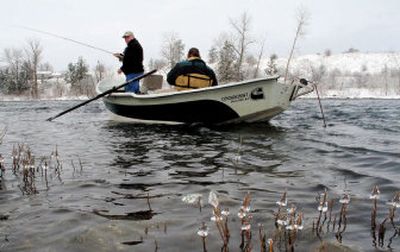
Jeff Holmes and Stann Grater had no competition for the trout chilling in the Spokane River on Jan. 21.
Not a soul was on the river as they rigged their fly rods, launched a drift boat near the state line and slipped into the solitude of the upper river. A 2006 change in Washington fishing rules has opened the upper Spokane to winter fishing – barbless hooks, no bait, catch and release – for the first time in memory.
“Fishermen can’t afford to turn their backs on this river,” said Holmes, a conservationist who’s trying to rally sportsmen to understand the river’s potential as well as threats that urgently need to be addressed.
“A lot of people don’t know what’s here so they don’t know what they’re losing,” said Grater, a fly-fishing instructor for the Orvis Co. and Spokane River guide.
Working along the snow-covered shoreline using full-sink lines and streamer patterns, Grater hooked and released an 18-inch rainbow and Holmes dittoed with a 15-inch brown in their short float to Harvard Road.
“This river has a lot more fly-fishing potential, but this is basically the only stretch we can fish out of a drift boat because there aren’t enough boat launches,” Grater said.
River access is just one of many issues that need to be confronted and now’s the time to do it, said Holmes, co-founder of the Hunting & Fishing Conservation Coalition. For example:
“Spokane Valley’s initial plans for construction at the Barker Road bridge, set to begin in 2008, do not clearly include maintaining one of the most important river access points for river floaters.
“Riverside State Park teamed with Spokane County and the city of Spokane Valley and the Department of Ecology last fall to clean up the river shoreline between Harvard Road and the state line. However, in December, with no public input, the agencies installed barriers to block vehicle access to popular areas of river shoreline, leaving little parking for anglers.
“Access points exist to the Spokane River from Maple Street downstream to the T.J. Meenach Bridge, but they are gated by the City of Spokane, preventing drift boat access.
“Proponents for a whitewater park proposed for the river near High Bridge Park and the Sandifur Bridge have not presented plans to assure the structure would not be a barrier to fish and angler passage.
“Development of the Valley and Rathrdum Prairie is sucking up 52-degree aquifer water that once recharged and cooled the upper Spokane River to temperatures better suited to trout.
“New sewage treatment plants are being discussed.
“Avista Utilities is releasing the draft plan for meeting requirements to relicense Post Falls Dam, and the Federal Energy Regulatory Commission (FERC) is holding a public-comment hearing in Spokane on Thursday. Relicensing occurs every 30-50 years, making these negotiations a rare opportunity to assure adequate flows for summer trout survival in the upper river.
Holmes, who says his family has been fishing the Spokane River for 40 years with everything from Rapalas to size 20 soft hackles, is pulling together an impressive list of speakers on Feb. 15 at the Inland Northwest Wildlife Council Center in a forum to bring sportsmen up to speed.
So far, the unofficial list for the Spokane River Anglers Forum includes:
“Grater, Dean Oakes and John Pirkkala, local sportsmen with decades of collective boating and various tackle angling experience on the Spokane River.
“Bruce Howard, Avista’s Spokane river license manager, the man coordinating all the interests that user groups, including anglers, have in the Post Falls Dam relicensing.
“Rick Eichstaedt, a Spokane angler and attorney who is challenging some of Avista’s relicensing plans based on his seven years of experience with Hells Canyon Dam relicensing and three years dealing with the Avista project.
“Doug Pineo, Washington Department of Ecology area coordinator for the state’s shoreline master program.
“Chris Donley, Washington Department of Fish and Wildlife district fisheries biologist.
The forum will be a rare chance to get so much background and current information in one spot, Holmes said.
Grater said he will have a big map of the Spokane River for sportsmen to mark their areas of concern.
“I’ve fished the river and been a drift boater for decades and I’ve talked a big game about the river, but I’ve never done much,” said Oakes. “I’m not glued to a fly rod. I’m a water guy, and I can see that there’s a broad base of people who see the need for better river stewardship.
“The river’s changing: lower summer flows, higher temperatures. If we leave this alone, anglers will lose out. We always do.”
The Spokane River links sportsmen and communities from its headwaters in the Bitterroot divide to the official beginning of the river at the outlet of Lake Coeur d’Alene and continuing downstream.
The river once ran free for 110 miles to the Columbia. Annual runs of steelhead and salmon fed the Spokane Indians, who gathered below the falls in what is now the city of Spokane.
Today, the Spokane River is tamed by seven dams. These, and other dams on the Columbia River, long ago put an end to the fish runs. Less than 36 miles – 20 percent – of the river remain free flowing. The 16 miles below Post Falls is the longest stretch of free-flowing water remaining.
“The best trout fishery on the river is in the lower river from Monroe Street downstream into Riverside State Park,” said Donley, who says up front that the Fish and Wildlife Department has never had the money to properly study the river’s fishery.
“The upper river has bigger trout, but not as many,” he said. “There are issues with reduced flows and warm water temperatures that we want Avista to tackle.”
Grater said anglers who regularly fish from the state line downstream already know there’s a problem. “The fishing in the upper river has clearly declined, and we really noticed it during the last dry summer,” he said.
The popular Centennial Trail, which runs along the river from Nine Mile Dam area to the state line, has spawned new appreciation for the water, sparked annual river cleanups, and slowed illegal dumping.
Still, the Spokane River faces the same threats as other urban waters. The Spokane has had the highest levels of toxic PCBs recorded in any Washington river. In a backhanded way, the state warnings to avoid eating the contaminated fish from the Spokane River is a boon to anglers who simply want to catch and release the trout.
Of course, the river will never be restored to its former angling peak.
Fishermen still quiver when they read the diary passage written by Lt. N. Abercrombie of the U.S. Army after he went fishing on Havermale Island (Riverfront Park) in 1877:
“Caught 400 (cutthroat) trout, weighing 2 to 5 pounds apiece. As fast as we dropped in a hook baited with a grasshopper, we would catch a big trout. In fact, the greatest part of the work was catching the grasshopper.”
But the river is still an outstanding fishery that could be even better with a little nurturing, Holmes said.
“We’re trying to collect the names of as many anglers and supporters and possible,” he said.