
Ex-driver has nowhere to turn
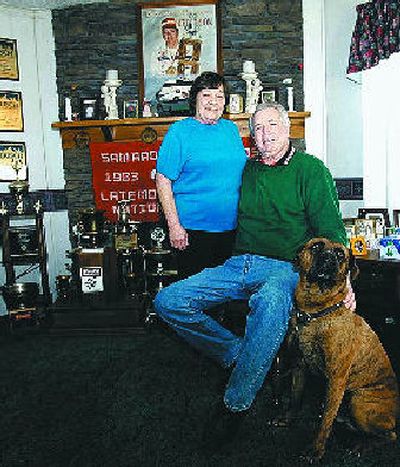
PAMPLICO, S.C. – The living room of Sam Ard’s brown doublewide trailer speaks to his short but successful NASCAR career. Trophies surround the fireplace and crowd its mantel. Plaques and pictures dot the living room walls.
What’s not there speaks to Ard’s life after NASCAR, the two championship rings and a handful of grandfather clocks from Martinsville Speedway that he sold because “we was running short on cash.”
Unlike veterans of other sports, Ard has no pension to fall back on.
As the booming stock-car series built by men such as Ard heads to Daytona International Speedway this week to kick off its 59th season, NASCAR remains the only major league sport without a pension plan.
“You can drive for NASCAR, but when it’s over, it’s over. You get nothing,” Ard said. “When you fall out of racing or something happens to you, it seems like NASCAR just forgets about you.”
Other leagues have pensions. Today’s 10-year veterans in baseball will receive a six-figure annual payout beginning at age 62. Even middle-of-the-road professional golfers can pile up millions under the PGA Tour’s deferred-compensation plan, which puts money away for players based on performance.
An NFL player with six seasons between 1998 and 2003 will get about $2,500 a month beginning at age 55, and the NBA has a similar plan. The NHL contributes about $45,000 per year to retirement accounts for veterans. The ATP and WTA tours make annual contributions averaging between $7,500 and $9,500 to retirement accounts for each tennis player.
NASCAR’s policy always has been that its drivers are “independent contractors” who bear full responsibility for their finances, health care, retirement and life insurance.
Few in NASCAR are arguing for a fund to help today’s drivers, who make millions from team contracts and more from race purses and merchandise sales. Jeff Gordon, the sport’s all-time money leader, has won a record $82,366,716 through 14 full seasons and isn’t sure what the responsibility should be.
“We don’t want to make NASCAR go broke like some other companies out there with pension plans have done,” said the four-time Nextel Cup champion. “We all need to be responsible for our actions.”
But if NASCAR wants to argue it rivals other sports in popularity, Gordon said officials shouldn’t be surprised when drivers ask for similar benefits.
“We are now competing with the NFL, basketball, the NHL,” Gordon said. “And so, should we be compared to them on every level? And when it comes to this subject, there is no comparison. I mean, I don’t even think we are on the board.”
Old-timers have lobbied for years for some sort of fund to help repay the men, like Ard, who contributed to the sport and now are struggling to make ends meet.
“It would almost cost nothing,” said Jack Ingram, the 1985 Busch champion. “It wouldn’t be many people that’s not wealthy that contributed a lot to this sport, but they’re … destitute. (Ard’s) a NASCAR champion; he’s living in a trailer house. It shouldn’t be that way.”
Ard, two-time Busch Series champion, has Alzheimer’s. Jo, his wife of 46 years, has a degenerative eye disease that’s slowly stealing her sight.
Between Social Security, Sam’s veterans benefits and what Jo picks up cleaning houses, the Ards bring in roughly $1,600 a month. After the mortgage payment of $426.96, car insurance on Ard’s 1993 Ford Ranger, utilities, phone and cable, there’s only about $123 left.
They don’t advertise their problems or complain, but individuals in the NASCAR community have stepped up to help.
From the desk near the fireplace Jo Ard pulls out a letter from Dale Earnhardt Jr. and Kevin Harvick that circulated through the NASCAR community late last year and was forwarded to her. She’s a proud woman, so showing it to a stranger isn’t easy.
“To All: Many of you may not be aware that one of NASCAR’s pioneers and champion, Sam Ard, is in very poor health and dire straits. … If it wasn’t for men like Sam, none of us would be able to enjoy the lifestyle we live today. We all do charity work and give back to the community, this time it’s one of our own.”
If Jo Ard had her way, the letter wouldn’t exist, and she and her beloved “Sammy” wouldn’t need handouts.
Although some inside NASCAR – specifically president Mike Helton and spokesman Jim Hunter – have given financial assistance on a case-by-case basis, they aren’t prepared to fund a pension.
“I think the biggest detriment to a pension plan, aside from the fact that they are not NASCAR employees, is trying to decide who would pay for it and what the eligibility factors would be,” Hunter said. “How many years would you go back? To 1948? Or would you start in the 50s? Or the 60s? Or the 70s? There’s a lot of issues that would need to be figured out.”
Tony Stewart, a two-time Cup champion who routinely dips into his own pocket to quietly support the old-timers, believes NASCAR could do more to help.
“I’m not going to say they have the responsibility, but it’d sure be nice,” Stewart said.