
Post-hurricane aid
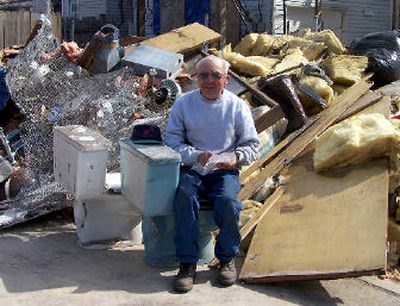
House by house, individuals and teams from Inland Northwest congregations and universities are sharing in post-hurricane recovery along the Gulf Coast – part of a web of healing and rebuilding.
By letting people know they are not alone, volunteers help restore trust, hope and energy for survivors of Hurricane Katrina to carry on despite blocks they encounter to rebuilding.
Overwhelmed by both the devastation and the gratitude they’re met with, many volunteers return feeling they were part of “something holy.”
Simultaneously, recovery efforts continue from the 2004 tsunami and earthquake in Asia, 2006 flooding in Western Washington and many other disasters through Church World Service, Catholic Relief Services and other faith and nonprofit groups.
Hurricane Katrina cleanup exemplifies how such groups collaborate to help people rebuild their lives.
Displayed next to the homes volunteers are mucking out or rebuilding are banners for Catholic, Evangelical, Presbyterian, Methodist, Lutheran, Jewish, Habitat for Humanity and other groups.
“I have never worked so hard, sweated so profusely or had such a feeling of accomplishment in my 74 years,” says Verna DuBois, one of five Chewelah United Church of Christ members who were part of a 35-member team from 13 Pacific Northwest UCC churches that visited in October.
She compared the situation to the story of an old man asked why he bothered to throw starfish back into the ocean.
“It matters to this one,” he said, flinging one of the creatures into the water.
“Each house is like a starfish – one house at a time,” says DuBois.
Three New Orleans UCC churches take turns hosting volunteers in staggered, three-week cycles that include one week off and two weeks providing lodging on air mattresses in Sunday school rooms, plus meals, laundry and cleanup facilities.
Presbyterian Disaster Assistance has five volunteer villages in Mississippi and Louisiana with corrugated plastic tents sleeping two or three on cots.
Several Inland Northwest Presbyterian churches have sent people.
On disability because of arthritis, and allergic to paint and mold, Lorraine Agte of Shadle Park Presbyterian Church wondered how she could help when she went with a group from her church and Northwood Presbyterian for a week in April to D’Iverville, near Biloxi, Miss.
Knowing “God can use us despite our limitations,” she found her niche driving crews to work sites; others would not drive in a strange city with street signs torn out by the storm.
Agte says people there are so impressed that volunteers from different denominations are helping that church attendance is up.
When people from Spokane’s Hamblen Park Presbyterian Church, especially those with relatives in Gulfport, Miss., wondered how to help, Susan Preuninger, lay ministries director, gathered them, and in September a group of 14 traveled to Gulfport.
“I realize how connected we are as churches and how God can use us anywhere to do things we could not do by ourselves,” Preuninger says.
“Everyone was grateful we came. They face so many decisions, it’s hard for them to know what to do next.
“Knowing people care enough to come helps them carry on.”
Episcopal Relief and Development set a five-year recovery plan for its dioceses in Mississippi and Louisiana, focusing on jobs, housing, health, counseling and church “adoptions.”
Bob Runkle, of the Episcopal Diocese of Spokane’s Social Justice and Outreach Commission, coordinates teams from around the country.
His church, St. Luke’s Episcopal in Coeur d’Alene, “adopted” Trinity Episcopal in Pass Christian, Miss.
In the Gulf Coast, volunteers roof homes, remove trees and shrubs, haul homeowners’ belongings to the sidewalk for a trash truck to pick up, strip walls and ceilings to the frames, spray them with bleach, and install new drywall, flooring, windows, wiring and doors, and paint.
“If I were in need, I would want someone to help,” says 16-year-old Jody Noreau of First Congregational UCC in Colville.
“I found it amazing that someone who lost everything was so happy with what she had, because she had not lost any family,” she says.
“It strengthened my faith to see people not give up or blame God.”
About half of the 14 Washington State University students who went to New Orleans for spring break in March 2006 with the Common Ministry are going back March 10 to 17, says the Rev. Robert Hicks, United Methodist campus minister with the Common Ministry in Pullman.
The 2006 group learned from the resilience of a homeowner who told of being transformed, seeing the possibility for new life after saying goodbye to memories and artifacts.
Seeing the students arrive, she said, “was like opening a door. I knew I could go forward.”
Spending time in March and May assisting a Lutheran-Episcopal Habitat for Humanity program in Biloxi reaffirmed for textile artist Suzi Hokonson of Spokane that “the nurturing work of talking with people is as important as building.”
She elicited stories of a woman who lost relatives, a physician’s wife who helped children in a day-camp deal with their trauma, and people who felt they did not deserve to talk if they had not lost a relative.
“When devastation is so massive, we need to show mercy, compassion and love,” summed up the Rev. Paul Rodkey of Bethany Presbyterian Church.
“That’s why it’s crucial for people to go there to volunteer.”
Even though what volunteers can do in a week is limited, most realize that without congregations and nonprofits recruiting, supporting and sending volunteers, little would be done.
Duane Nightingale of Veradale UCC says his engineer co-workers wondered if it would have been better to send the $6,000 his group spent on airfare for a February 2006 trip.
That would have replaced the church roof and siding but would not have been enough to repair flood- and wind-damaged homes.
Nightingale believes the volunteer work was worth three times the airfare.
“When we respond to God’s call to help,” he says, “there is meaning and value that cannot be measured.”