
Rituals after death
If you’re of a certain age, you’ll remember pulling your car over to the side of the road when a funeral procession passed. You stepped out and, if you’re a man, you probably removed your hat and placed it over your heart.
Chances are it’s been many years since you performed that reverential act. It was part of last-rite rituals that faded out locally during the 1970s, according to the two Coeur d’Alene funeral directors, Bruce English and Dexter Yates.
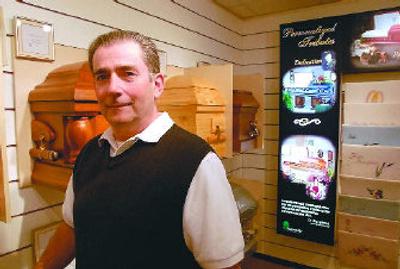
The businessmen, both successors to their fathers in their family-owned businesses, describe how rituals, practices and even equipment related to death have changed over the years in North Idaho.
If you’ve not noticed, the limousines that used to carry family members and pallbearers from funeral services to the cemetery have disappeared from our streets.
“We had two of them,” Yates says. “Nobody asks for them anymore, so we phased them out.”
And hearses aren’t used to transport remains to funeral homes these days. Instead, both funeral directors own several vans that blend with traffic.
A tradition that’s long gone is a three- to five-night viewing of the deceased’s body before burial. The reasoning behind that old practice, Yates explains, is that in the pre-jet plane past, it often took relatives and friends several days to journey to Coeur d’Alene.
Now, says English, viewings are generally limited to a single evening, and they take place at the funeral home, not in the decedent’s residence.
Pre-funeral viewings are not as popular here as they are in other parts of the country, especially the Midwest, they note. There, oftentimes more people attend them than attend the funeral.
Yates explains that in North Idaho, friends often say they want to remember the deceased as they were in life and not in a casket.
Still, local tradition dictates that the casket will be open at the conclusion of a funeral, they say.
Many of today’s local mourners no longer wear the dark clothing that was once traditional here, and remains traditional in the Midwest, back East, and even in Southern Idaho, according to the funeral directors.
Both say it’s not unusual for family and friends to show up for funerals dressed in jeans, shorts and, on occasion, even with bare midriffs.
Black armbands that, in years past, denoted a person in mourning, haven’t been worn locally in perhaps a half-century, the men say. The only remnant of that tradition is the black tape worn on the badges of police officers and firefighters to honor fallen comrades.
The rosaries that once were held the night before Catholics’ funerals were, by Church decree, supplanted by “vigils” in 1989. Those are still gatherings of friends and family members, and perhaps some Hail Marys and Our Fathers are recited, but the rituals are now more personalized and more comfortable for non-Catholics, English and Yates say.
Funerals, too, are more personalized these days than they were in more formal times past. The men describe accoutrements special to the deceased such as fishing rods, golf clubs – even chain saws – now decorating funeral parlors at the request of family.
Videos that show vignettes of the deceased’s life are very popular, they say, and friends and family members often take part in funeral services, a departure from the more ritualized services of old.
An awkward change over the years has been the presence of former mates, children and relatives at funerals. Hostility isn’t uncommon, they say, and sometimes feuding family factions have to be seated apart from each other.
Multiple marriages and serial relationships once gave funeral directors severe headaches, with current spouses, former spouses, live-in partners and children of different parents each making demands on such issues as final disposition of a body.
Because of that confusion, the 1996 Idaho Legislature wrote a law that defines who has the authority to make such decisions. In order of descending precedence, those are:
•The person, if he or she has a pre-paid contract with a funeral home;
•if there is no such contract, the person who has durable power of attorney for the health care of the decedent;
•the competent surviving spouse;
•the majority of the adult surviving children;
•the parents; or
•the executor of the estate.
The funeral directors point out that the statute does not recognize a common-law spouse. Hence, he or she cannot make decisions related to the disposition of the body of the person with whom he or she had lived.
That disposition, of course, means either cremation or burial, and North Idaho holds the national lead in the percentage of persons cremated, according to Yates.
He says 75 percent of us end up in the funeral homes’ crematory, versus a national average of 32 percent. Cremation is preferred by only 10 percent of Midwestern residents and 46 percent of Idahoans statewide.
Both funeral directors credit our proclivity for cremation to the fact that North Idaho has had a major influx of people from other parts of the nation, with no strong ties to the community or a religion that discourages the practice.
“It’s obviously easier and less expensive to ship cremated remains rather than send a body to a family plot elsewhere,” English says.
“Besides,” he notes, “cremation has become fashionable over the past few years.”
They point out a couple of traditions that remain, even in this fast-paced and transient world: One is that bodies are generally buried facing east.
Dr. Ronald Hunter of the Coeur d’Alene Church of the Nazarene explains that that practice is rooted in a Christian tradition related to resurrection day.
The tradition, he says, is that, just as surely as the sun rises daily in the east so too will Jesus, the son of God, return to earth on resurrection day.
And, wives’ bodies are generally laid to rest to the left of their husbands’, just as they were standing when they were united in marriage.