
Good vibes
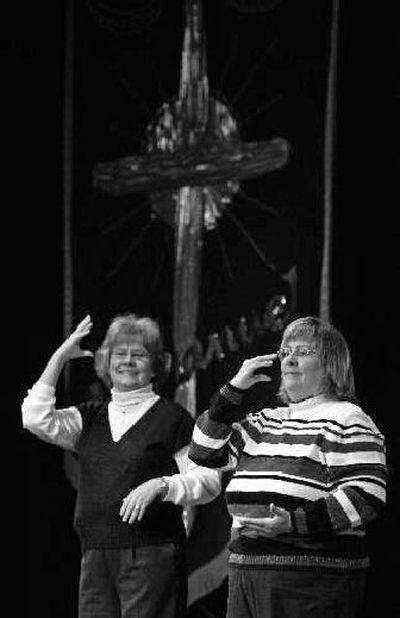
BRENTWOOD, Tenn. – Brian Sims was sitting in traffic when a car with a booming stereo pulled up next to him. Feeling vibrations from the pulsating vehicle, the Baptist pastor who ministers to the deaf got an idea: creating a one-of-kind church exclusively for deaf people.
Today, the Brentwood Baptist Deaf Church has more than 30 speakers beneath the floor so congregants can feel the vibration of the music.
Many churches provide sign language for deaf and partially deaf worshippers, but this church in a Nashville suburb is unique because it was built specifically with a deaf ministry in mind.
“There is a hearing church, basically, on every corner, but there’s not really anyplace like this,” Sims says. “It’s a place where the deaf know, ‘This is for me,’ that it meets their needs.”
The church has a loop system that allows anyone with a hearing aid to tie into the sound system with the flip of a switch.
Also, each seat is wider to give church members more space to communicate in sign language.
The Southern Baptist church has about 150 people who attend, with Sunday services that are now simulcast for 600 to 700 people in 16 locations across the country.
Sims says he wants the church to become a training ground for deaf pastors and church leaders, because seminaries typically require that deaf students have their own interpreters, and most can’t afford such an expense.
The church held a pilot conference last year to train deaf pastors and leaders, with about 100 people from around the Southeast attending. A national conference is planned for fall.
Texas architect Cynthia Stiles, who designed the church, says she couldn’t find any structure like it as she was in the planning stage. Stiles, who also is deaf, says having a clear line of sight to the altar area as well as good lighting and music were crucial in the church design.
Often, churches that have interpreters for the deaf have carpets and pews that deaden vibration. Large pillars and other obstacles can obstruct views of the altar, and too many windows can cause a glare.
“If you’re a deaf person, I think it makes the service more meaningful to be able to feel the music from the floor,” Stiles says through an interpreter. “The (violet) coloring from the walls makes it easier to see.
“The acoustics (make it) easier to understand the message and to communicate better.”
The National Association for the Deaf estimated in the late 1990s that there were only about 1,000 mainly deaf congregations nationwide for the nearly 30 million deaf and partially deaf Americans.
Kathy Black, professor at Claremont School of Theology and a former chaplain at Gallaudet University for the deaf, says there are likely fewer deaf ministries now than in the past because many don’t get the funding they need to survive.
“A lot of the mainline Protestant churches are struggling financially, and when it comes to budget cuts, (deaf ministry) is often the first to go,” Black says. “It’s expensive to pay an interpreter. Churches think it’s a large amount of money for a relatively small population of people.”
Sims, whose adoptive parents are deaf, notes that some studies have shown that between 80 percent and 90 percent of deaf people don’t attend church. He believes that’s likely because churches don’t have interpreters and other accommodations.
Brentwood Baptist Church hired Sims in 1995 to start a full-time ministry to the deaf, but the church’s current location wasn’t built until 2003, after it received a $1.5 million donation. Before that, the church held services in different facilities.
“Historically what takes place in a deaf church that’s under a hearing church is they’re moved from place to place because they’re low man on the totem pole,” Sims says. “Deaf work is not a money maker.”
Black says that’s part of why the Brentwood Baptist Deaf Church is so unique.
“That’s the first church I’ve every heard of that’s built for deaf people,” she says. “Most of the deaf churches just struggle to survive. It puts the deaf front and center.”
Janet Clark, 64, of Nashville, began to attend the Brentwood deaf church in the mid-‘90s after she lost part of her hearing from an inner-ear disease.
“My husband and I were attending a hearing church,” Clark says. “But when I could no longer hear the minister’s sermon, my husband asked me if I wanted to attend the deaf church.
“At my former hearing church, I could hear nothing. But at the deaf church I can understand everything.
“So it is such a blessing to be in an environment where I can function and participate fully.”