
From stiff to star: Al Gore’s unlikely Hollywood story
LOS ANGELES – In the annals of vice presidential history, tonight will be something different.
In his black tux, the man known to his most fervent fans as “The Goracle” will arrive by hybrid eco-limo and, surrounded by fellow Hollywood greenies Cameron Diaz and Leonardo DiCaprio, will stroll down the red carpet at the Academy Awards to answer the immortal question: “Al, who are you wearing?”
What a year it has been for Al Gore and his little indie film.
“An Inconvenient Truth,” the 100-minute movie that is essentially Gore giving a slide show about global warming, is the third-highest-grossing documentary ever, with a worldwide box office of $45 million, right behind blockbusters “Fahrenheit 9/11” and “March of the Penguins.”
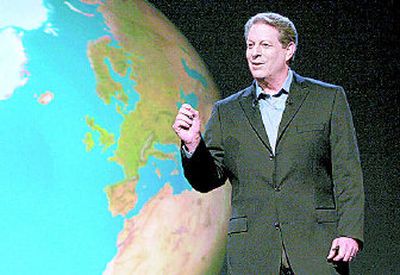
“AIT,” as Team Gore calls it, is also the hot pick for Best Documentary, and if its director, Davis Guggenheim, wins an Oscar, he plans to bring Gore along with him to the stage to accept the golden statuette and perhaps say a few words about … interstitial glacial melting? (More likely, Gore will deliver a favorite line about “political will being a renewable resource.”)
In the year since his film premiered at the Sundance Film Festival to a standing ovation, Gore has gone from failed presidential contender – and a politician who at times gave new meaning to the word cardboard – to the most unlikely of global celebrities.
Incredible as it may seem, Gore is not only totally carbon neutral, but geek-chic cool. No velvet rope can stop him. He rolls with Diddy. He is on a first-name basis, for real, with Ludacris. But what does this mean? And how did it happen? Did Gore change? Or did the climate – political, cultural, actual – change around him?
In an e-mail exchange with The Goracle himself, “AG” typed to the Washington Post that the Oscar craziness and pageantry of the film premieres has been “fun” (his word) “but I’m old enough to know that a red carpet is just a rug, so I’ve been able to enjoy that part of it without losing perspective.”
Just a rug, people. Because Gore continued (this was on Friday during a break from his tux fitting): “Actually, for me, the most moving moments have been in conversations with people who have told me that the movie had a big impact on the way they think and feel about our moral responsibility to protect the Earth.”
“He is more popular now than he ever was in office, and he knows it,” says Laurie David, one of the producers of “Inconvenient Truth” and a Hollywood environmental activist (and wife of “Seinfeld” co-creator Larry David) who has traveled around the world promoting the film with Gore. “He’s a superhero now.”
Before the film? He was more Willy Loman than Green Avenger. After his loss in 2000, a battered Gore began to schlep around the country, often solo, flying coach, giving his ever-evolving slide show about climate change, a threat that Gore, now 58, says he has felt strongly about since his Harvard days.
After the film? Says director Guggenheim, “Everywhere I go with him, they treat him like a rock star.”
Guggenheim is not being hyperbolic. Take the Cannes Film Festival: Al Gore was mobbed. By French people. He was a presenter at the Grammy awards, alongside Queen Latifah, where he got one of the biggest welcomes of the night. “Wow. … I think they love you, man. You hear that?” the current Queen asked the former veep. Earlier this month, the ticket Web site at the University of Toronto crashed when 23,000 people signed on in three minutes to get a seat to hear Gore do his thing on the oceanic carbon cycle. At Boise State University, Gore and his slide show sold out 10,000 seats at the Taco Bell Arena, reportedly, “faster than Elton John.”
Remember that this is the same Al Gore who, even today, interrupts himself to explain that while he supports the use of ethanol to reduce greenhouse gas emissions, please, he is not talking about regular ethanol; he is talking about “cellulosic ethanol” (made from wood chips rather than corn starch).
Also remember that “An Inconvenient Truth” was not on anybody’s short list for theatrical release, let alone an Oscar. “I think I was the only person crazy enough to want it,” says John Lesher, president of Paramount Vantage, which purchased the film at Sundance. “Everybody else had already passed on it, to be honest, but I thought if we do our job right, this could be a zeitgeist moment.”
And nobody worked for the film harder than Al Gore, Lesher says. “He was an amazing collaborator, and unlike everyone else in Hollywood, he did everything he said we would do, which is unique in my experience.”
Gore worked the premieres in Edinburgh, Helsinki, Oslo, Stockholm, Sydney, Hong Kong, Amsterdam, Zurich, Brussels, Berlin and Tokyo. In France, he not only attended the film opening but also presented his 90-minute Apple Keynote lecture to the National Assembly. He did the slide show at the United Nations, the American Geophysical Union, and before conservative activist Grover Norquist’s Wednesday group.
“I am trying to reach out to people in every effective way that I can find,” Gore wrote in his e-mail. “In the process, I have had the chance to work with really interesting people from all walks of life.” Meaning: eggheads and rappers, movie moguls and prime ministers, and, more recently, Bon Jovi. “So, pop culture is an important part of the message delivery system, but far from the only part.”
Gore’s book, based on the film, has sold 850,000 copies worldwide and translation rights for 24 languages. In Spain, Prime Minister Jose Luis Rodriguez Zapatero told Gore that the DVDs of the film would be shown in the public schools, following similar proclamations in Scotland and Norway. And speaking of Norway, earlier this month Gore was nominated for a Nobel Peace Prize for his work to alert the world to the dangers of climate change.
“People ask him all the time what does he attribute his recent success to, and Gore tells them ‘reality,’ ” says Larry Schweiger, a friend and president of the National Wildlife Federation, who is a leader of Gore’s Alliance for Climate Protection, a foundation that seeks to bring evangelicals, hunters, farmers and entrepreneurs to the cause. “They used to ridicule him. They called him a tree-hugger. They don’t do that anymore.”
Guggenheim explains: “People say to me that Al Gore is so different now. Why wasn’t he like this when he ran for president?” Meaning that Gore now appears relaxed, confident, happy, and not stiff, robotic, pinched. “They say Al has changed. But I don’t think so. We’ve changed. The setting has changed. He’s the same. When you’re running for office, you’re a target every moment you are in front of the camera. Now, he’s in a different place, and we see him in a different way.”
“Is being president better than this?” muses Simon Rosenberg, head of the New Democratic Network. “I think what Gore’s figured out how to do is something that a lot of people want to do. He’s living a life of great freedom and pursuing his interests, and he’s having an impact on public policy. He’s been able to start a bunch of companies and do the movie, and he’s got this great life right now.”
“I agree,” Gore typed, “that the zeitgeist has begun to change. I think it reflects the increased popular will to confront and solve this crisis. It’s an extraordinary experience to see this issue – which the conventional wisdom used to say was politically marginal – become central for so many people. As it should. I also think that people see candidates through a different lens, and that is a factor. But I also think there is at least a grain of truth to the old cliche that ‘what doesn’t kill you makes you stronger.’ So maybe I’ve gotten a little stronger in last six or seven years.”