
Spokane to unveil a special place for last days

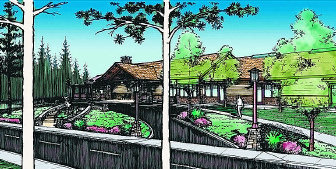
When the time comes, the majority of people would choose to die at home, surrounded by loved ones and the familiar comforts of their own house.
Often, though, that is not possible.
Some people may live alone and not have anyone to take care of them. Others may be in unbearable pain or suffering from other symptoms that can’t be treated at home.
Currently, those people would likely spend their final days in a hospital or nursing home.
But a new facility called Hospice House, scheduled to open in Spokane this fall, aims to change that.
A groundbreaking ceremony will be held today to mark the beginning of construction on the 12-bed, $5.2 million dollar Hospice House.
“It fulfills a much-needed health-care void here in the local community,” says Dr. Pierre Soffe, medical director for Hospice of Spokane, which will run the house. “It will provide a special place where people will be able to spend their final days, surrounded with a real sense of peace, dignity and compassion, and receive the best possible medical, emotional and spiritual care at the end of life’s journey.”
Spokane resident Bob Thayer witnessed firsthand the importance of a hospice house.
Thayer’s elderly father, Frank, who lived in the Tri-Cities, was dying of lung cancer in 2005. The 89-year-old wanted to stay in his own house, but it became increasingly difficult as his condition worsened.
“He was really failing. We were spending all of our weekends down there,” Thayer says. “We weren’t able to focus on him because we were becoming the caregivers. … It came to a point where we just didn’t know what to do.”
Then the Thayers heard about a hospice house in the Tri-Cities, the closest one to Spokane.
The Thayers liked the large, homelike feel of the room. Family members could spend the night; visitors could drop in whenever they wanted. Hospice staff checked not only on the patient, but on the family, too, to see if they needed help or counseling, he says.
One evening, Frank Thayer requested breakfast at 7 p.m. It was served to him.
“If he wanted to be read to, they would read to him,” Bob Thayer says. “If he wanted to go outside, each room had access to the outside.”
Although his father spent just three days at the house before his death, Bob Thayer calls the experience “a gift” because he got to spend the final days with his dad as a son, not as a caregiver.
“Then when I realized we didn’t have one in Spokane, it kind of blew me away,” he says. “It’s something we’re all going to need – ourselves or our parents.”
Spokane’s Hospice House has been a long time coming.
In 1999, Hospice of Spokane bought property in Spokane Valley, intending to build the facility there. But the agency decided in 2005 that the center should be located near the downtown hospitals.
The Spokane Valley land has since been sold, says Gina Drummond, the hospice’s CEO.
“We really wanted to create a beautiful and calming space where all would feel welcomed from the moment they enter,” says Drummond, who helped open a hospice house in Great Falls, Mont. “We want to bring a healing presence to patients and families.”
Hospice officials are still looking to raise nearly $3 million for the Hospice House, after having raised a little more than $2 million. But the project will proceed regardless of whether all the money is in the bank, Drummond says.
“We’re feeling pretty good about it,” she says. “As the community starts to catch the momentum, we’re looking for more support.”
Dr. Joni Nichols, a medical oncologist in Spokane and part-time medical director at Hospice of Spokane, says organizers are not discounting the quality of care provided by area hospitals.
“It’s just more of a sterile setting,” she says. The Hospice House, she says, will fill an important niche.
In some cases, there’s simply no further treatment a hospital can provide, and yet the patient’s family may not be able to handle the difficult care-giving tasks during a loved one’s final days.
“There’s a lot of very personal care, wiping bottoms and cleaning up spit,” Nichols says. “It’s really hard for parents to let children do that or for a spouse to let a spouse do that.”
Nichols’ grandfather died in a hospice house in Arizona, she says.
“We were just able to be the family and not necessarily be the caregivers,” she says.