
Traditional simplicity
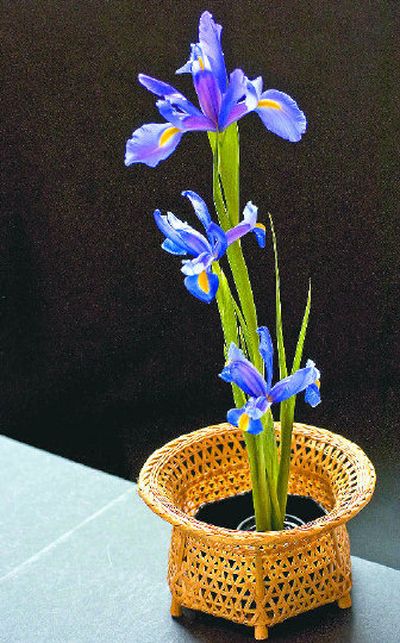
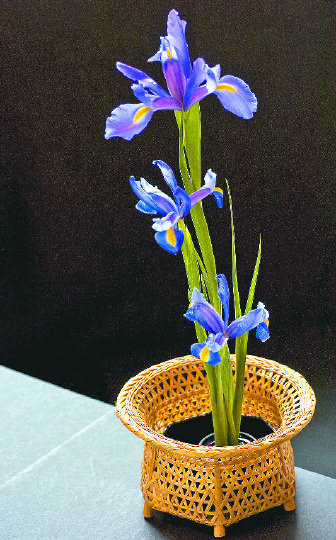
Ikebana is the art of Japanese flower arranging. It originated as a ritual floral offering made in Buddhist temples. In this style, floral arrangements are based on an asymmetrical triangle. The tallest line is called Tai (Heaven), the shortest line Yu (Earth) and the flowers halfway between are called So (Man).
Lee McLeron is a member of the Spokane chapter of Ikebana International, and has been practicing this ancient art for 33 years. “I like the simplicity of ikebana,” she says. “It’s all about visual balance.”
Traditional western arrangements emphasize the color and quantity of the blossoms. This Japanese method focuses instead on the linear aspect of the design.
For the arrangement pictured, McLeron chose a deep, broad dish and placed an aqua cup inside. You can also use a needle cup to hold the arrangement. McLeron says if your local florist doesn’t have these in stock, they will order them for you.
Next, she carefully pulled the greenery from the iris. She placed the tallest stem, the tai, in the cup first. Then she added the shortest bloom and balanced the arrangement with some of the green leaves she’d removed from iris earlier.
You don’t clutter the bottom of the arrangement with additional blossoms or greenery. Finally, McLeron filled the aqua cup with enough water to spill out into the container. The end result should look natural, like flowers you’d find growing in a field.
“With ikebana, less is more,” McLeron says.