
Affirming life: Residency program gives lessons on hospice and palliative care
In their training, doctors spend a lot of time learning how to take patient histories, how to make diagnoses, and how, of course, to treat disease.
But there’s one thing new doctors don’t spend much time doing: Learning how to care for people who are dying.
A new program that combines Spokane’s internal medicine residency program, Hospice of Spokane and the palliative medicine program at Deaconess Medical Center hopes to give these physicians a lesson in end-of-life care.
Third-year internal medicine residents in Spokane now must participate in a required one-month rotation in hospice and palliative care. Only a handful of programs around the country offer such a rotation for residents.
“A big part of it is hands-on experience, providing hospice care to patients in home settings,” says Dr. Pierre Soffe, medical director for the hospice. “We’re hoping to really make a difference as far as educating the next generation of young physicians.”
Seven residents a year will take part in the hospice rotation. They’ll learn pain-management techniques, along with how to assess whether a person needs further medical care. But there’s more than medicine to be learned, Soffe says.
By working with hospice and palliative care, the residents will learn how to focus on a patient’s emotional, psychological and spiritual needs, he says. The residents will work with doctors, nurses, social workers and others.
“They affirm the person’s life, the life story,” Soffe says.
Patients become eligible for hospice care when they are not expected to live more than six months. Palliative care is for people who have an incurable, life-limiting illness but may have a longer life expectancy.
All too often, though, patients and their families do not learn about hospice until death is imminent – too late to reap all of the program’s benefits.
“There’s a general misunderstanding of what hospice care is all about,” Soffe says. “We see it as a really significant developmental phase in the life journey.”
More than 80 percent of older Americans would prefer to die at home, a Gallup poll found. But in Spokane County, fewer than 30 percent of deaths occurred at home, according to department of health statistics.
Changing that statistic is one of the goals of the new program.
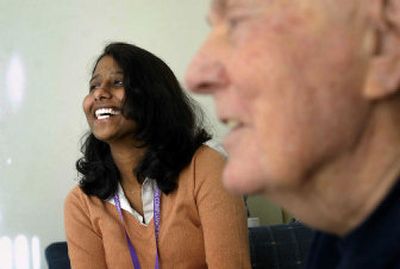
“This will definitely help me determine which patient is appropriate for hospice,” says Prashanthi Ganathi, the second resident in the hospice rotation.
Ganathi, 29, came to the United States from India four years ago to study medicine.
During her sometimes emotional stint on the hospice rotation, she has been struck by the personal connection formed with patients, one that stretches beyond medical care.
“Patients are so lonely and they like to talk to people,” Ganathi says.
In a clinical setting, Ganathi might see a patient for 20 minutes. During a hospice home visit, she’ll spend one or two hours.
That’s what she did one day last month at the South Hill home of Bill Hutchins. Hutchins, who turned 88 a couple of days ago, has congestive heart failure.
“It’s been determined there simply isn’t any more that can be done,” says one of his daughters, Barbarann Elliott. Elliott, a retired nurse, takes care of her dad in his home with the help of her sister, Eileen Pilant.
So, Ganathi listens to Hutchins tell World War II stories.
And then she asks some questions:
“Any shortness of breath?
“Chest pain?
“Cough?
“Weakness in your legs?
“You taking all of your medications?”
Hutchins says mostly he feels OK, at least not any worse than he did a few months ago. Then he says to Ganathi:
“You have no idea, any of you, how being in this condition makes me feel. Now, all of a sudden, here I sit. To me, it’s humiliating … To me, 88 is just a couple of numbers but the old body says that’s a bunch of bull.”
Ganathi listens to his heart and lungs, noting his irregular pulse and heart murmur.
And then she returns to listening to the stories of his life.
A sticker with the hospice phone number is stuck to Hutchins’ phone.
“I really thank God for hospice every day,” Elliot says, stressing how much her dad wants to stay in his own home. “Sometimes we lose sight of the patient’s feelings because we are so keyed in to their medical needs. You need to be able to treat patients holistically.”