
Bob Hoff and Ag Info Network look to cultivate larger audience
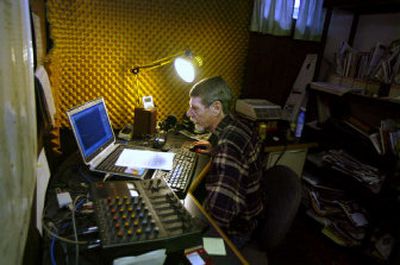

For 15 years Bob Hoff has been the reigning “voice” of farm news on the airwaves of Eastern Washington. The Spokane broadcaster is the range-tested voice heard by farmers, ranchers and their families listening to radio stations across the Inland Northwest.
He’s the latest in a long line of agriculture newscasters roaming by pickup to spend hours chewing the fat with growers and ranchers, attend farm conventions and then summarize trends in agri-business.
Hoff, who’s 56, is one of three full-time reporters working for the Pacific Northwest Ag Information Network, blanketing the region with reports on crop research, commodity prices and changing patterns affecting the way ranchers and farmers manage their business.
His boss, Kelly Allen of Cashmere, gives Hoff and the other two ag reporters all the credit for keeping the Ag Info Network profitable as he heads into the still-uncertain future for small networks serving the agriculture community.
Even so, Allen, who’s owned Ag Info Network since 1994, knows his company’s future relies on expanding his audience and the number of stations that carry his programs. The future of ag radio, said Allen and others in the business, means developing more programs catering to the fast-growing population of small, semi-rural farmers who are proliferating across the West.
Instead of worrying about large companies taking over smaller farms, the ag-broadcast industry is trying to target what Allen calls the “martini farmers” moving to 10 or 15 acre plots just outside a city, where they hold regular jobs.
“We don’t have to worry about the mainline farmers. They still listen to us. We are instead trying to find ways to provide content for the people who’ve moved to small farms for a rural lifestyle,” Allen explained.
Allen is seen by other ag-network owners as an innovator for creating two programs that try to offer lifestyle segments for the suburban farm crowd. One is the daily feature “American Rancher” and another is “Vine to Wine,” a weekly radio segment produced by Portland resident Linda Moran.
The “Rancher” segment is done by Jeff Keane, a Douglas County rancher and former rodeo rider. Allen says the show is a mix of commentary, humor and ranching news.
“It’s the kind of segment stations will carry in their afternoon drive time,” Allen said.
Even Hoff knows that some adjustment is needed to address that new market, made up of folks who have seldom owned a tractor but now typically need one to manage their plots of land.
“Some stories try to talk about owning horses,” said Hoff, “since lots of those small farmers have them.”
But he’s not sure if he’s able to help target the martini farmers with “lifestyle” stories, added Hoff: “I don’t want to do horse stories. That’s not my forte.”
The concern over developing ways to reach that market has spurred the National Association of Farm Broadcasting to sponsor a conference next month in Kansas City solely devoted to that topic,
Jeremy Povenmire, who works for the NAFB — which represents about 130 companies that produce farm news nationwide — said Allen’s strategy makes sense, but isn’t something every network owner can do.
“If you have a network in the Corn Belt, you’d be restricted in developing a strategy based on appealing to the new small-plot farmer,” he said. “But in some other regions it makes great sense, and Kelly (Allen) is one of our members who’s aggressive in testing ideas for that market.”
Adapting to new technology
Allen, who grew up on a farm near Pendleton, declines to give sales figures for Ag Info Network. Povenmire, speaking about farm networks nationally, said most are enjoying annual growth of 5 to 6 percent.
“We’re definitely tied to how the farm economy is doing,” said Allen. “When farmers have less money to spend, our advertisers realize they won’t be able to sell as many products to farmers as in good times.”
While most listeners may think farm reports are stuck in the mold of crop prices, hog belly futures and weather forecasts, the industry has shifted toward modern technology, especially in the way segments are produced and distributed to the stations.
Until 10 years ago, Allen relied on using tape as the primary way reporters like Hoff recorded their programs. Hoff said he’d record a week’s worth of taped segments within a few days then mail them off to the network. “It didn’t let you do anything too fresh,” he said.
For the past five years, Hoff and the other Ag Info Network reporters record their interviews with digital voice recorders. They then dump the files into PCs, write a script and record the entire segment, and finally they upload them as mp3 files to the Ag Info server in central Washington.
Before the segments are finished, Allen and an assistant produce the full segment, inserting 30-second commercials into the middle of the news report.
Once the segments are produced, they’re posted to Ag Info’s Web site, where radio station staff then find them and download them for the next morning or afternoon show.
“It’s less expensive for us to use the Web to distribute the segments now,” Allen said. Until he moved to Web delivery, stations had to get the segments off of a satellite system.
He said it cost $2,500 a month before to lease time on the satellite. Today, he spends far less money to maintain the Web site. “The other advantage is the Web site lets me know when or if a station downloads the segment,” Allen added.
That’s important because radio stations don’t pay Allen for the segments. He charges advertisers for the spots inserted in the shows. The radio stations agree to carry segments in order to attract farm listeners at key times during the day. Then the stations sell their own advertising in the time slots right before or right after the Ag Info segments.
“Some days a radio staff guy is sick and they don’t download our show,” Allen said. “So we call them back and they realize they missed it, so they agree to do a make-right for us.”
If he didn’t insure the segments were aired, Allen would have difficulty convincing advertisers their commercials are reaching as many people as he’s saying they do.
The primary advertisers on Ag Info Network, he added, are chemical companies selling herbicides and pesticides, animal health-service firms that provide veterinary products, and banking and insurance companies.
Allen said his expected revenue growth will come from increased ad sales; it’s not likely Ag Info Network will add new affiliate radio stations soon, he said.
That’s because most station program directors will not carry news segments from Ag Info Network if a competitor in town is already doing so.
Spokane, however, breaks that rule. Two AM stations, KGA and separately owned KQNT, both carry some of the segments to appeal to the area’s farmers.
Allen’s nearest competitor is the Billings, Mont.-based Northern Broadcasting System, which delivers agriculture news to 77 stations in Montana, southern Idaho, Colorado, Wyoming and parts of the Dakotas.
Taylor Brown, the owner of NBS, describes his programming as more traditional than the fare provided by Kelly Allen at Ag Info. His schedule is tailored to a region with a stronger agriculture base where most farmers and ranchers still expect and demand to have news and not much lifestyle fluff, Brown said.
Brown’s crowded daily schedule of news and information is much closer to the classic Midwest ag-radio model — based on a steady drumbeat of hourly commodity price reports, frequent weather forecasts and a mix of news about crops, cattle and future indexes.
Brown said today’s farm community also wants news on fishing and hunting, on rodeo events and updates on key legislative bills affecting farmers. “The Montana legislature just opened this week, so we made sure we told our listeners what the major bills are there this session,” Brown said.
Most of the stations carrying NBS segments schedule them in the traditional early morning and noon slots. “Farmers today are tremendously busy. They don’t have time to sit down and watch the morning news drinking coffee.
“They say, ‘Give me the news I want quickly. What’s the weather, what’s the legislature doing, and I gotta get out of here,’ ” said Brown.
By contrast, when he looks at Ag Info Network’s schedule, Brown sees far more program diversity. “That’s because the Northwest farm economy is far more diverse. It’s not all grain and cattle over there.”
Brown has been doing this long enough to know the radio industry will never return to the days when every small or mid-sized city had several farm broadcasters working for every major AM station there.
Today, the pattern is finding just one station in each town carrying farm news. But the major advantage enjoyed by NBS and by Ag Info Network, Brown added, is the human quality of their programs.
“People want to hear voices that sound like it’s from their own community. When you listen to the Clear Channel or giant national radio broadcasts, the voices sound like they’re from anywhere.
“What we do is to provide unique programming that’s unique to each area. It’s not the same stuff you get on all the other stations.”