
Lessons in learning: Education pioneer believed learning should be enjoyable
WASHINGTON – The kids who scampered about construction zones in the San Lorenzo slums of Rome gave the work crews fits. Then the builders heard some woman doctor was recruiting students for a new school. They begged her to enroll the troublemakers in the Casa dei Bambini.
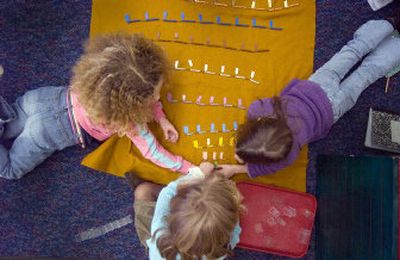
Maria Montessori agreed. Her Children’s House offered a few dozen young students freedom. They could sort blocks, measure with beads, play with wooden letters or explore another project of their choice. They roamed through classrooms rather than building sites.
The results of this experiment launched in January 1907 captivated the education world, inspiring a movement over the next century that has helped define child-centered education.
More than 5,000 Montessori schools are spread across the United States, at least 8,000 worldwide.
The American Montessori Society, based in New York, reported 7 percent membership growth in just the past year, and many of the schools are getting ready to celebrate the centennial of the Montessori beachhead.
Once considered a maverick experiment that appealed only to middle-class white families in the States, Montessori schools have become popular with some black professionals and are getting results in low-income public schools with the kind of children on which Montessori first tested her ideas.
The stubborn Italian physician and her contemporary, U.S. philosopher and psychologist John Dewey – who believed that learning should be active – are considered perhaps the most influential progressive thinkers in the modern history of education.
But Montessori has had the more tangible impact, with versions of her child-centered practices passed from preschool teacher to preschool teacher, some not even aware of the origins of what they are doing.
Nowadays, her advocacy of unstructured class time seems antithetical to today’s structured classrooms, with their emphasis on standardized testing and meeting the mandates of the federal No Child Left Behind law.
“One test of the correctness of educational procedure is the happiness of the child,” Montessori said. She also declared: “The greatest sign of success for a teacher … is to be able to say: ‘The children are now working as if I did not exist.’ “
There are 250 to 300 public Montessori schools nationwide. American Montessori Society President Michael J. Dorer, an education professor at the College of St. Catherine in St. Paul, Minn., said creating more public schools would be the best way to break out of the upper-income niche that in some ways still limits the Montessori movement’s growth.
Dorer said his college and several others train Montessori teachers, but there are not enough instructors with credentials to meet demand from the expanding number of Montessori schools. Some schools with the Montessori name don’t have many, or any, Montessori-trained teachers. “Anyone can open a school and call it a Montessori school. There is no trademark on the name,” Dorer said. “It’s a real problem.”
Maria Montessori, who lived from 1870 to 1952, was a pioneering doctor in Italy. She gained international notice when the severely learning-disabled students she worked with passed educational tests designed for nondisabled children.
In her 2005 book “Montessori: The Science Behind the Genius,” University of Virginia psychologist Angeline Stoll Lillard described how Montessori viewed the learning-disabled. Such children were often locked up in bare rooms, Lillard wrote, their food thrown at them. Montessori saw “their grasping at crumbs of food on the floor as starvation not for food, but for stimulation,” she wrote.
Montessori developed a system of learning for all students, disabled and otherwise, in large open classrooms with low shelves, with tables of different sizes that fit one to four children and with chairs sized for children of different ages. Montessori classes often group children in three levels: ages 3 to 6, 6 to 9, and 9 to 12. The older students help the younger.
Various materials, mostly made of wood, are set out in a typical classroom. Children choose what they want to do. A child may decide to focus on learning to tie his shoes rather than recognize letters – while his mother grits her teeth. But eventually, according to the Montessori way, he will get around to the materials that help teach reading and math because all the activities are meant to be inviting. Children move around rather than sit still and watch the teacher.