
Putting giving on plastic

MARTINEZ, Ga. – At the Stevens Creek Community Church, God takes credit cards.
Debit cards, too.
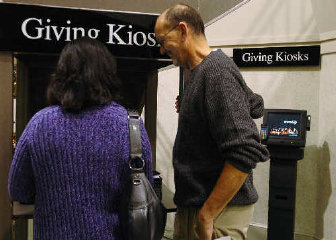
Two “giving kiosks” sit just outside the church’s chapel. They are next-generation collection plates that allow churchgoers to swipe their credit or debit cards and instantly send donations to the church.
Pastor Marty Baker likes to call the black terminals ATMs – “automatic tithe machines.”
“We’re just trying to connect with the culture,” Baker says. “And that’s how the culture does business.
“It’s more than an ATM for Jesus. It’s about erasing barriers.”
Baker came up with the idea three years ago when his east Georgia church was preparing for a fundraising drive. He realized that, like many in his 1,100-member congregation, he rarely carried cash; he hired developers to find a way for his flock to pay with plastic.
Eventually they cobbled together a prototype that he set up at his church in early 2005.
Since then, the evangelical church has seen an 18 percent bump in donations – and an average gift of more than $100 each time a card is swiped.
The results encouraged Baker and his wife Patty to form a company called SecureGive that sells the terminals for between $2,000 and $5,000 apiece and charges a $50 monthly subscription fee.
The kiosks are fairly simple to use. After typing in a phone number and pin number, users swipe a credit or debit card.
The terminals allow users to give to a specific fund, such as a building drive or a mission. Afterward, it spits out a receipt.
At Stevens Creek, where services begin with flashy light shows and an in-house Christian band jams out salvation songs, the embrace of technology has helped foster a sense that this congregation is on the cutting edge.
“We’re real. We’re in today,” says church volunteer Dorna Adams.
Baker compares his technology to the days of the Old Testament when people stopped offering sacrifices and started offering coins.
“It’s the same now with bringing plastic,” he said. “It’s an evolution – and this will take root.”
To placate churches concerned that parishioners will donate money they do not have, the company offers to build machines that accept only debit cards.
To the Bel Air Presbyterian Church in Los Angeles, it was the price that was galling, not the concept. The church considered buying the kiosks before deciding to build a homemade version for a few hundred dollars, says Jeremy Turgeon, the church’s information service manager.
In some ways, the rise of the kiosks is a natural extension of the online donations that many church Web sites now accept. Phill Martin of the National Association of Church Business Administration expects even some of the most resistant churches to eventually offer some sort of credit-based donations.
“Whether we’ll have an offering plate with a card reader one day, who knows,” Martin says. “But we’re certainly not far from that.”
The real market, though, may wind up being nonprofit groups.
Baker’s company recently reached a deal with the Oregon Ballet Theatre, which debuted two of the kiosks last month during “Nutcracker” performances. He’s also in talks with New Orleans boosters to set up kiosks around town so visitors and residents can donate to a rebuilding fund.
The machines haven’t signaled an end to traditional collecting at Stevens Creek.
Proceeds from the machines account for only one-fifth of the money the church’s donations. During a recent Wednesday night baptism ceremony, volunteer ushers proudly sprang to attention when called to collect offerings, ready to pass the basket.
Even so, the modern-day donation plate in the church atrium usually grabs most of the attention.
Amy Forrest, a 31-year-old who drives an hour from her South Carolina town on Sundays to attend services, says she knew the church was the right fit for her the first time she saw the kiosks.
“This church gets how I live,” she says.
Forrest says the machines make it much easier for her to chip in her weekly $40 donation.
“If you give cash, you think about it. And if you swipe a credit card, you don’t,” she said.
“It makes it easier to type that 4-0,” she says.
“And it makes it easier to break down to the Lord.”